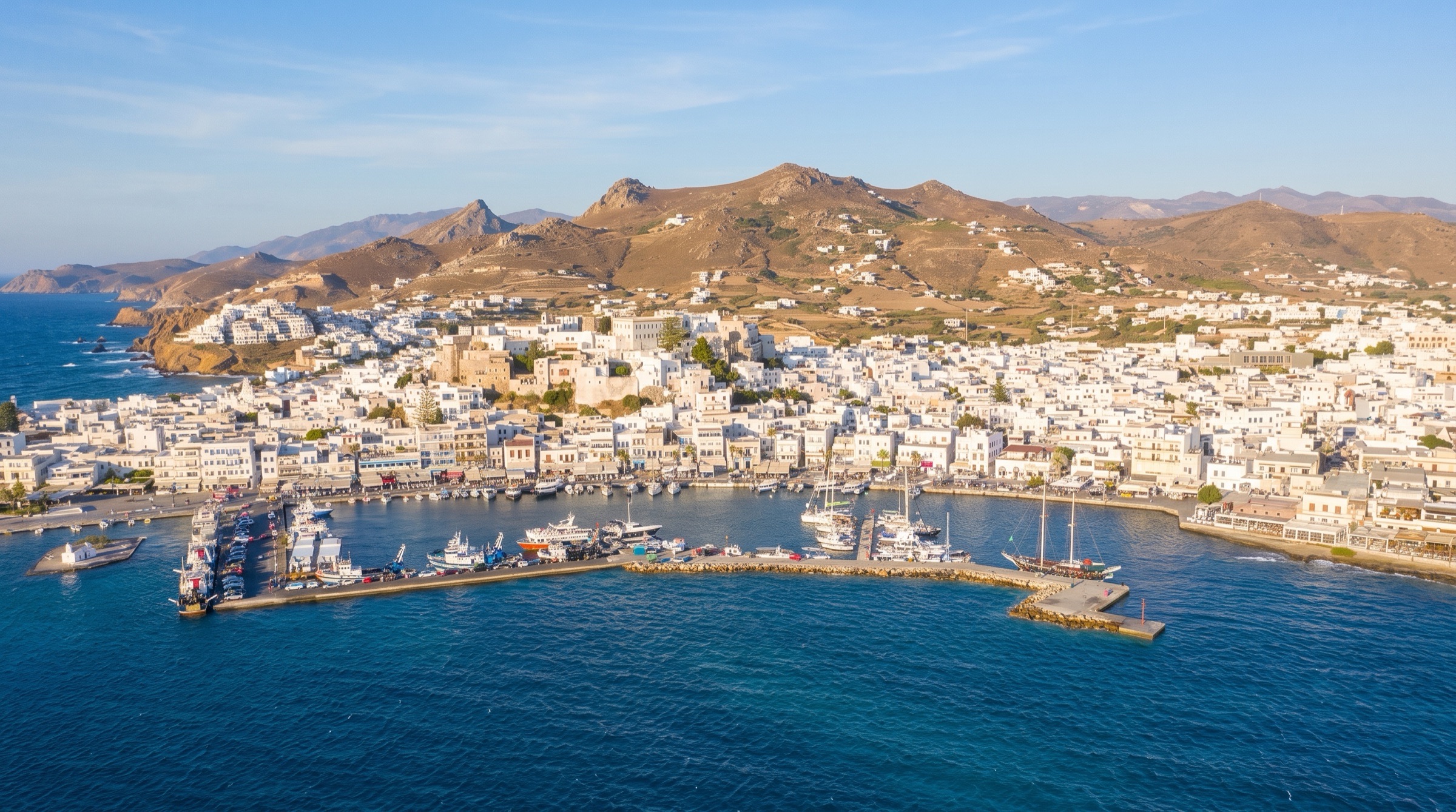
 AI image
Mediterranean
Central Cyclades
The central Cyclades run from Mykonos and Delos through Paros, Naxos and the Small Cyclades to Santorini. Expect whitewashed villages, ancient sites and lively harbors, plus remote beaches around Koufonisia and Amorgos. Santorini's caldera has deep water and few anchorages, so plan marinas and moorings in advance.
Best months
Difficulty
ChallengingStrong meltemi, long island passages and crowded summer harbors.
Conditions
The meltemi blows north to northeast, Force 5-7 in July and August, with steep seas in channels such as Paros-Naxos and Mykonos-Tinos. Downslope gusts hit lee anchorages. May, June, September and October are calmer. Harbors fill early in summer.
Area guide
Greece — Cyclades
Greece
The Cyclades are a ring of roughly 220 islands (about two dozen inhabited) in the central Aegean, arranged around sacred Delos, with Syros's Ermoupoli as the regional capital and Naxos the largest island. For sailors this is the most dramatic cruising ground in Greece: whitewashed Choras above deep anchorages, volcanic coastlines at Milos and Santorini, sand-and-turquoise bays in the Small Cyclades, and short 10-30 nm hops between islands. The defining factor is the meltemi, the north wind that blows from about June to September and peaks in July and August, often at 20-30 knots and sometimes stronger. It makes the Cyclades a superb downwind and reaching ground but punishing to windward, so routes are planned south early and back north in early-morning legs, and every overnight stop is chosen by its shelter from the north. Most charters leave from Lavrio or Alimos (Athens) or from island bases on Syros and Paros. Harbours are a mix of town quays (stern-to, Mediterranean mooring, often free or cheap but crowded and ferry-washed) and a few true marinas; anchoring in sand is the norm everywhere else. This area file covers the islands in 12 subregions from the Attica gateway to Santorini and Anafi.
Top of the list
- 1Kleftiko AnchorageMilos's pirate cove of white volcanic arches and sea caves; overnight in calm weather to have it to yourself after the tripper boats leave.
- 2Sarakiniko BeachA lunar landscape of wind-carved white pumice on Milos's north coast — a calm-day lunch stop unlike anything else in the Aegean.
- 3Delos Archaeological SiteUNESCO sacred island of Apollo; day-anchor in the Delos channel and walk the Terrace of the Lions. No overnight stays.
- 4Pori Bay (Pano Koufonisi)Turquoise sand bay in the Small Cyclades with good sand holding; the archetypal Cyclades swim-and-anchor stop.
- 5Captain John's Moorings (Thirasia)The practical way to spend a night inside the Santorini caldera, where depths are too great to anchor.
- 6Hozoviotissa Monastery11th-century monastery bolted into a 300 m cliff above Amorgos's east coast — one of the great sights of the Aegean.
- 7Despotiko Anchorage (Despotiko–Tsimintiri)Clear shallow sand anchorage between uninhabited islets off Antiparos, beside the excavated Sanctuary of Apollo.
- 8Polyaigos AnchoragesLargest uninhabited island in the Aegean; protected Natura 2000 waters, sea caves and white-sand coves between Milos and Kimolos.
- 9Kolona Anchorage & Sandbar (Kythnos)Twin coves divided by a sand spit to Agios Loukas islet — sheltered from both meltemi and southerlies; a classic first-week stop.
- 10Ermoupoli Marina (Syros)The neoclassical capital of the Cyclades: all-weather harbour, shipyard, chandlery and the best provisioning between Athens and Paros.
- 11Naoussa Marina (Paros)Postcard fishing harbour under a Venetian castle with a big sheltered bay outside for anchoring and the Kolymbithres granite beaches nearby.
- 12Vathy Bay (Sifnos)Nearly enclosed bay on Sifnos's southwest coast with a sandy beach, tavernas and a whitewashed chapel on the waterline.
- 13Temple of Poseidon, Cape SounionThe marble temple on the cape you round leaving Lavrio — anchor below it for sunset on the first or last night.
- 14Folegandros ChoraClifftop Chora with car-free squares and the zigzag path to Panagia church; reached from Karavostasis harbour.
- 15Serifos Chora & KastroWhite Chora tumbling down a crag above Livadi harbour; walk the old stone path up for the view.
- 16Panormos Bay (Tinos)Marble-carving fishing village on Tinos's north coast with tavernas and the hike up to Pyrgos.
- 17Kalotaritissa Bay (Amorgos)Turquoise bay at Amorgos's southwest tip sheltered by Gramvousa islet, near the Olympiakos wreck.
- 18Gala Beach & Devil's Eye (Koufonisi)Rock pools and the 'Piscina' sea pool on Pano Koufonisi's south coast, reached by dinghy or coastal walk.
- 19Nea Kameni Volcano HikeWalk the still-steaming craters of Santorini's youngest volcanic island, then swim at the Palea Kameni hot springs.
- 20Portara Temple of Apollo (Naxos)The giant marble doorway on the islet at the mouth of Naxos harbour — the landmark you steer for on arrival.
- 21Vourkari Anchorage & Quay (Kea)Kea's sheltered inner bay, the standard first night out of Lavrio, with waterfront tavernas and the Agia Irini ruins.
- 22Kedros Beach (Donoussa)Remote sand bay on the least-visited Small Cyclades island, with a WWII wreck in the shallows.
- 23Manganari Bay (Ios)Wide sand bays on Ios's south coast, a southern-shore refuge when the meltemi blows.
- 24Batsi Harbour (Andros)Friendly village harbour on Andros's west coast, the first stop for boats coming down from the Kafireas strait.
- 25Little Venice (Mykonos)Sunset drinks on balconies over the water beside the Mykonos windmills.
When to go
Main season May to October. May-June and September-early October are the sweet spot: warm water, fewer crowds and meltemi episodes that are usually shorter and weaker. July-August bring the strongest and longest meltemi (often Force 5-7 by day, sometimes more) plus peak crowds and prices; many advisers send less experienced crews to Kea, Kythnos and Syros from Lavrio in high summer rather than Mykonos, Naxos or Santorini, or to the Saronic Gulf or Ionian instead. Winter (Nov-Mar) sailing is possible but marked by gales from both north and south, reduced ferry and taverna service, and many harbours with little shelter from southerlies.
Weather and hazards
Meltemi (etesian wind): a dry N-NE wind (more NW in the south Cyclades) driven by high pressure over the Balkans and the heat low over Anatolia. Season mainly June-September, peaking July-August; typically builds late morning to early afternoon, often to Force 5-7 (17-33 kn), and may ease at sunset but can blow through the night and persist several days (sometimes up to about ten). Steep short seas build quickly — over 3 m within hours of a 30-kn blow across long fetches. Acceleration zones: the Kafireas (Kavo Doro) strait between Evia and Andros, the Andros-Tinos and Mykonos-Tinos channels, the Paros-Naxos channel, north of Amorgos, and sometimes south of Kea and Kythnos. Katabatic fall winds ('downslope gusts') hit lee anchorages hard under high ground: Kea, Andros, Tinos, Serifos (Livadi), Sifnos (Kamares, Vathy), Folegandros, Amorgos and Ios. Warning signs 24-36 hours ahead: rising pressure over the Balkans/northern Aegean, sudden drop in humidity (no dew on deck), altocumulus and very sharp visibility, and orographic cloud caps on island peaks. Tactics: go south early in the week, leave at dawn for any windward leg, plan 1-2 weather days, anchor on south- and southwest-facing coasts and lay out plenty of chain. Other hazards: heavy ferry and high-speed-craft wash in Paros, Mykonos, Naxos, Milos, Kea and Tinos harbours (keep clear of ferry berths and their laid anchor lines); crowded town quays in July-August with crossed anchors; deep water close inshore (Santorini caldera depths are hundreds of metres — use moorings); unlit or poorly charted rocks on some approaches (do not enter Gavrio, Andros, at night); summer thunderstorms and occasional southerly gales (sirocco) in spring and autumn when north-facing harbours become the safe ones.
Hurricane season
No tropical cyclone season. Rare Mediterranean 'medicanes' (tropical-like cyclones) mostly form in autumn and winter; the main seasonal wind risk is the summer meltemi plus autumn-winter gales and southerly sirocco blows.
Entry and clearance
Greece is EU and Schengen. EU-flagged, EU-VAT-paid yachts arriving from another Schengen/EU country generally have no customs clearance, but practice varies and some Port Police (Limeniko) offices still ask yachts to report on arrival with registration, insurance, crew list, passports and the eTEPAI receipt. Non-EU yachts (and EU yachts unable to prove VAT-paid status) need a Greek Transit Log: since 2024 it is applied for online through the myAADE portal (Applications > Customs Services > Transit Log) before arrival; boats with EU VAT-paid 'Union Goods' status receive an unlimited-duration log, others an 18-month log with continued check-in/out at controlled ports. Cruisers reported in 2025 being fined (€300 in one report) for not applying online before arriving, though Customs can still issue one if the system fails. Non-EU crew must enter at a port with passport control and observe the Schengen 90/180-day rule. In the Cyclades area, Lavrio is the usual first stop from the mainland, with Port Police and Customs offices reported at Olympic Marine (verify current status); for a definitive list of current ports of entry, check Noonsite's Greece formalities pages or a Greek yacht agent. Charter yachts' paperwork is handled by the charter base. Report to the Port Police in each port where they ask; in larger harbours (Syros, Paros, Mykonos, Naxos, Milos) expect them to check papers.
Permits and fees
TEPAI (cruising tax): payable by private and professional pleasure vessels over 7 m in Greek waters, paid online via the AADE eTEPAI service before or on arrival, per calendar month (minimum one month). AADE rates: over 7 m to 8 m €16/month; over 8 m to 10 m €25; over 10 m to 12 m €33; above 12 m €8 per metre per month (verify current rates on aade.gr). Discounts exist for professional vessels; boats hauled out or declared out of use are exempt for those months. Transit Log: online application via myAADE (a €29.50 fee was quoted in a 2025 cruiser report — verify locally). Harbour dues: many Cyclades town quays charge modest municipal fees collected by the port fund, often with separate water and electricity cards (about €10 a night cited in a 2026 Lavrio-Kos report); marina rates quoted by cruisers in 2026 ranged from free to about €110 a night — verify locally. Mykonos's new marina requires online booking. Delos: day visits only (archaeological site ticket required ashore), no overnight anchoring. Keros: protected archaeological island, landing prohibited. Bareboat charter: skippers need a recognised licence (ICC, RYA Day Skipper or equivalent) and charter companies generally require a second crew member with sailing experience; VHF certificate requirements vary by company.
Tides and currents
Tides are negligible: Aegean tidal range rarely exceeds about 10 cm, so depths on charts can be used at face value (watch barometric/wind setup of a few tens of centimetres). Currents are mostly wind-driven: during strong meltemi, surface currents run S-SW through the channels and reach several knots in the Kafireas strait between Evia and Andros (up to 5 kn reported). Sources: HCMR Mediterranean Marine Science paper on Aegean tides; Hellenic Navy Hydrographic Service (HNHS) charts and tide tables; CruisersWiki NE Aegean notes.
Money
Euro (EUR). Cards widely accepted in towns and marinas; carry cash for small-island tavernas, harbour dues and water/electricity at remote quays. ATMs in island main ports (fewer on the Small Cyclades, Anafi, Sikinos, Donoussa).
Radio and phones
Emergencies: Hellenic Coast Guard 108 (sea emergencies) or 112 (EU general emergency); VHF 16 for distress. Port Police / port authorities: VHF 12 (Ermoupoli port listens on 12). Hellenic Coast Guard HQ channel 07. Olympia Radio (Greek coast radio): VHF 16 calling; weather and sea bulletins in Greek and English on working channels — the Syros station broadcasts on VHF 04 for the Cyclades (verify schedule). NAVTEX 518 kHz: Iraklio (station I, covers Central and South Aegean, Saronikos and Kafireas strait) and Limnos (L). Forecasts: Hellenic National Meteorological Service (emy.gr, 'Greek seas'), HCMR Poseidon system, plus the usual GRIB models. Marinas: Olympic Marine VHF 09 (per Noonsite listing). Mobile coverage is good across the main islands (Greek 4G/5G networks; EU roaming applies), patchy in some remote bays (e.g. Kalotyri, Amorgos).
Charter bases
- Olympic Marine (Lavrio)Lavrio, SE Attica — about 30-40 minutes by road from Athens International Airport; the closest mainland base to the Cyclades (Kea is about 13 nm). Note: The Moorings and Sunsail now list Zea Marina, not Lavrio, as their Athens base (checked October 2026).Olympic Yachting, Dream Yacht Charter
- Lavrio Port (town marina)Lavrio town centre; charter companies use the town pier, fuel by truck at the pierVarious independent operators (verify with the base)
- Alimos Marina (Athens)Alimos, south Athens coast — about 20 minutes by taxi from Athens airport per Kavas; the largest marina in Greece; under redevelopmentKavas Yachting (piers 7-8), Dream Yacht Charter (temporary office opposite piers 8-9), Kiriacoulis Mediterranean (A27/A28), ISTION Yachting (A57-A58), Vernicos Yachts (A42/A43), Sailways (A55), Athenian Yachts (A1/A2), About 30 more operators on the marina's service-provider list
- Zea Marina (Piraeus)Piraeus, about 15 minutes from central Athens; D-Marin marina (VHF 09). The Moorings and Sunsail both name Zea as their Athens base (company sites checked October 2026).The Moorings, Sunsail
- Syros — Ermoupoli Marina & FinikasSyros, central Cyclades; regional capital with shipyardEscale Yachting, Other island operators (verify)
- Paros — ParikiaParos west coast; closest bareboat base to Santorini, Folegandros, Amorgos and MilosSeveral local charter companies (verify current)
- Mykonos, Milos, Santorini (secondary bases)Mykonos New Port (Tourlos), Adamas (Milos), Vlychada (Santorini)Mostly skippered/crewed and one-way charters (verify)
Getting there
- Athens International Airport Eleftherios Venizelos — ATHMain international gateway. About 30-40 minutes by road to Lavrio and about 20 minutes to Alimos (per charter-company guides). Rafina and Piraeus ferry ports serve all the Cyclades.
- Mykonos Airport — JMKInternational (seasonal) and domestic flights.
- Santorini (Thira) International Airport — JTRInternational seasonal flights and domestic flights from Athens.
- Paros National Airport — PASDomestic flights from Athens; international routes have been intermittent.
- Naxos Island National Airport — JNXDomestic flights from Athens.
- Milos Island National Airport — MLODomestic flights from Athens.
- Syros Island National Airport — JSYSmall domestic airport.
Charts and guides
- Rod & Lucinda Heikell, Greek Waters Pilot (Imray, 14th ed. 2022) — single-volume pilot to 450+ Greek harbours
- Rod Heikell, West Aegean (Imray) — detailed coverage of Attica and the adjacent Cyclades
- Imray chart G31 Northern Cyclades (2024 ed.) — plans of Kea (Ay. Nikolaou), Finikas, Naoussa, Mykonos, Gavrio
- Imray G-series charts for the Central/Southern Cyclades (verify current numbers)
- Hellenic Navy Hydrographic Service (HNHS) official charts
- Navionics / Navily / noforeignland anchorage databases (crowd-sourced; cross-check)
- Noonsite Greece country pages (formalities, docking per island)
Sample routes
- 7-day Western Cyclades loop from Lavrio (meltemi-friendly)Day 1 · Olympic Marine (Lavrio) → Vourkari Anchorage & Quay (Kea) · 13 nmShort shakedown across the Kea channel; dinner on the Vourkari waterfront. Distances approximate.Day 2 · Vourkari Anchorage & Quay (Kea) → Kolona Anchorage & Sandbar (Kythnos) · 15 nmSwim off the sand spit; sheltered from both N and S.Day 3 · Kolona Anchorage & Sandbar (Kythnos) → Livadi Bay Anchorage (Serifos) · 22 nmBroad reach south; walk up to Serifos Chora & Kastro for sunset.Day 4 · Livadi Bay Anchorage (Serifos) → Vathy Bay (Sifnos) · 15 nmShort hop; tavernas on the sand at Vathy; visit Kastro and the Seven Martyrs chapel by taxi.Day 5 · Vathy Bay (Sifnos) → Finikas Marina (Syros) · 30 nmLongest leg — leave at dawn to cross before the meltemi fills in.Day 6 · Finikas Marina (Syros) → Ermoupoli Marina (Syros) · 10 nmNeoclassical Ermoupoli, Miaoulis Square, Ano Syros; reprovision.Day 7 · Ermoupoli Marina (Syros) → Olympic Marine (Lavrio) · 45 nmEarly start back to base, optionally via Kea; charter return is usually Friday evening.
- 14-day Grand Cyclades from Lavrio (south early, return north in morning legs)Day 1 · Olympic Marine (Lavrio) → Vourkari Anchorage & Quay (Kea) · 13 nmKea channel crossing; Agia Irini ruins. Distances approximate.Day 2 · Vourkari Anchorage & Quay (Kea) → Loutra Marina (Kythnos) · 15 nmThermal hot springs on the beach.Day 3 · Loutra Marina (Kythnos) → Livadi Bay Anchorage (Serifos) · 24 nmSerifos Chora sunset.Day 4 · Livadi Bay Anchorage (Serifos) → Kamares Harbour (Sifnos) · 12 nmSifnos food culture; Apollonia and Kastro.Day 5 · Kamares Harbour (Sifnos) → Adamas Marina (Milos) · 25 nmInto Milos bay; Plaka and the catacombs.Day 6 · Adamas Marina (Milos) → Kleftiko Anchorage · 12 nmSea caves and arches; stay the night if calm.Day 7 · Kleftiko Anchorage → Polyaigos Anchorages · 15 nmUninhabited protected island; then Kimolos Psathi for dinner.Day 8 · Polyaigos Anchorages → Karavostasis Harbour (Folegandros) · 25 nmBus or walk up to Folegandros Chora.Day 9 · Karavostasis Harbour (Folegandros) → Captain John's Moorings (Thirasia) · 30 nmInto the Santorini caldera; Oia sunset across the water.Day 10 · Captain John's Moorings (Thirasia) → Ios Marina (Gialos) · 20 nmNea Kameni volcano walk in the morning, then north to Ios.Day 11 · Ios Marina (Gialos) → Pori Bay (Pano Koufonisi) · 30 nmSmall Cyclades turquoise water; Gala Beach & Devil's Eye.Day 12 · Pori Bay (Pano Koufonisi) → Naoussa Marina (Paros) · 30 nmDawn start; windward work around Naxos's south coast if the meltemi is up.Day 13 · Naoussa Marina (Paros) → Ermoupoli Marina (Syros) · 22 nmClose reach north-west to Syros.Day 14 · Ermoupoli Marina (Syros) → Olympic Marine (Lavrio) · 45 nmEarly departure; Sounion temple on the way in.
- 7-day Small Cyclades & Amorgos loop from ParosDay 1 · Parikia Marina (Paros) → Despotiko Anchorage (Despotiko–Tsimintiri) · 10 nmShallow turquoise anchorage and the Sanctuary of Apollo. Distances approximate.Day 2 · Despotiko Anchorage (Despotiko–Tsimintiri) → Livadi Beach (Iraklia) · 28 nmDownwind run past Naxos's south coast.Day 3 · Livadi Beach (Iraklia) → Mersini Harbour (Schinoussa) · 5 nmTsigouri beach and Chora tavernas.Day 4 · Mersini Harbour (Schinoussa) → Pori Bay (Pano Koufonisi) · 6 nmGala Beach & Devil's Eye; dinner in Koufonisi Chora.Day 5 · Pori Bay (Pano Koufonisi) → Katapola Harbour (Amorgos) · 15 nmBus up to Chora and the Hozoviotissa Monastery.Day 6 · Katapola Harbour (Amorgos) → Kalantos Bay & Harbour (Naxos) · 28 nmRemote all-weather Naxos south-coast harbour.Day 7 · Kalantos Bay & Harbour (Naxos) → Parikia Marina (Paros) · 25 nmEarly start through the south of the Paros-Naxos channel.
Places in Greece — Cyclades
- AB Food Market (Chora ring road)Stores · Mykonos
- AB Vassilopoulos (Antiparos)Stores · Antiparos
- AB Vassilopoulos (Ermoupoli Ferry Terminal)Stores · Syros
- AB Vassilopoulos (Neorion, Iroon Square)Stores · Syros
- AB Vassilopoulos (Parikia, Parasporos road)Stores · Paros
- AB Vassilopoulos Supermarket (Kea)Stores · Kea (Tzia)
- AB Vassilopoulos Supermarket (Tinos Town)Stores · Tinos
- Abela (Ampela) Cove (Syros)Anchorage · Syros
- Abram Bay (Naxos)Anchorage · Naxos
- Achivadolimni (Rivari) Beach (Milos)Beach · Milos
- Achivadolimni Anchorage (Milos Bay)Anchorage · Milos
- Achla Bay Anchorage (Andros)Anchorage · Andros
- Achla Beach (Andros)Beach · Andros
- Achladi Taverna (Vari)Eat · Syros
- Acropolis & ParthenonLandmark · Attica mainland (Athens)
- Adamas Anchorage (Milos Bay)Anchorage · Milos
- Adamas Fuel (Milos)Service · Milos
- Adamas Laundry (Milos)Service · Milos
- Adamas Marina (Milos)Marina · Milos
- Adamas Port Police (Milos)Permit · Milos
- Aegean Maritime Museum (Chora)Landmark · Mykonos
- Aegean Market (Gialos, Ios)Stores · Ios
- Aegiali ELINOIL Fuel Station (Amorgos)Service · Amorgos
- Aegiali Harbour (Amorgos)Marina · Amorgos
- Aegiali Kayak, Canoe & SUP Rental (Amorgos)Watersport · Amorgos
- Aegiali Medical Office (Amorgos)Service · Amorgos
- Aegiali Pharmacy (Amorgos)Service · Amorgos
- Aegiali Port Police (Amorgos)Permit · Amorgos
- Aegiali Provisions & Fuel (Amorgos)Stores · Amorgos
- Aetos Bay (Syros)Anchorage · Syros
- Africa Shipwreck (Sarakiniko)Dive · Milos
- Agathopes Beach (Syros)Beach · Syros
- Aggelos Bakery (Kamares, Sifnos)Stores · Sifnos
- Agia Anna (Paraga) SnorkelSnorkel · Mykonos
- Agia Anna & Agios Prokopios SupermarketsStores · Naxos
- Agia Anna & Kalafatis Bay (Mykonos)Anchorage · Mykonos
- Agia Anna Anchorage (Amorgos)Anchorage · Amorgos
- Agia Anna Beach (Amorgos)Snorkel · Amorgos
- Agia Anna Beach (Naxos)Beach · Naxos
- Agia Anna Harbour (Naxos)Anchorage · Naxos
- Agia Anna–Paros Water Taxi & Day CruisesTour · Naxos
- Agia Irini Archaeological Site (Vourkari)Landmark · Kea (Tzia)
- Agia Irini Bay (Kythnos)Anchorage · Kythnos
- Agia Irini Bay (Paros)Anchorage · Paros
- Agia Irini Beach (Kythnos)Beach · Kythnos
- Agia Irini Beach (Thirasia)Beach · Thirasia
- Agia Irini Beach Anchorage (Thirasia)Anchorage · Thirasia
- Agia Irini Chapel & Valmas Walk (Ios)Hike · Ios
- Agia Kyriaki Bay (Milos)Anchorage · Milos
- Agia Marina Festival (Antiparos, July 15-17)Event · Antiparos
- Agia Marina Monastery (Andros)Landmark · Andros
- Agia Marina Tower (Kea)Landmark · Kea (Tzia)
- Agia Thalassa Cove (Panormos, Tinos)Anchorage · Tinos
- Agia Theodoti Bay (Ios)Anchorage · Ios
- Agiassos Bay (Naxos)Anchorage · Naxos
- Agioi Anargyroi Beach (Anafi)Beach · Anafi
- Agios Andreas Acropolis (Sifnos)Landmark · Sifnos
- Agios Dimitrios Bay (Kythnos)Anchorage · Kythnos
- Agios Dimitrios Beach (Kythnos)Beach · Kythnos
- Agios Dimitrios Cove (Milos Bay)Anchorage · Milos
- Agios Fokas Beach (Tinos)Beach · Tinos
- Agios Georgios Anchorage (Antiparos)Anchorage · Antiparos
- Agios Georgios Bay (Sikinos)Anchorage · Sikinos
- Agios Georgios Beach (Folegandros)Beach · Folegandros
- Agios Georgios Beach (Naxos)Beach · Naxos
- Agios Georgios Harbour (Iraklia)Marina · Iraklia
- Agios Georgios Outer Anchorage (Iraklia)Anchorage · Iraklia
- Agios Georgios Provisions (Iraklia)Stores · Iraklia
- Agios Georgios Rocks Snorkel (Sikinos)Snorkel · Sikinos
- Agios Ioannis Anchorage (Glyfa, south Paros)Anchorage · Paros
- Agios Ioannis Bay (Kythnos)Anchorage · Kythnos
- Agios Ioannis Bay (Milos West)Anchorage · Milos
- Agios Ioannis Bay (Mykonos)Anchorage · Mykonos
- Agios Ioannis Beach (Serifos)Beach · Serifos
- Agios Ioannis Cave Feast (Iraklia)Event · Iraklia
- Agios Ioannis Cave Hike (Iraklia)Hike · Iraklia
- Agios Ioannis Snorkel (Mykonos)Snorkel · Mykonos
- Agios Loukas Islet (Kolona)Beach · Kythnos
- Agios Nikodimos Feast (Naxos Town)Event · Naxos
- Agios Nikolaos Beach (Folegandros)Beach · Folegandros
- Agios Nikolaos Beach (Sikinos)Beach · Sikinos
- Agios Nikolaos Harbour (Anafi)Marina · Anafi
- Agios Nikolaos Lighthouse (Kea)Landmark · Kea (Tzia)
- Agios Nikolaos Monastery (Andros)Landmark · Andros
- Agios Nikolaos Taverna (Folegandros)Eat · Folegandros
- Agios Panteleimonas Beach (Sikinos)Beach · Sikinos
- Agios Pavlos Beach (Amorgos)Beach · Amorgos
- Agios Petros Bay (Tinos)Anchorage · Tinos
- Agios Petros Beach (Andros)Beach · Andros
- Agios Prokopios Anchorage (Naxos)Anchorage · Naxos
- Agios Prokopios Beach (Naxos)Beach · Naxos
- Agios Romanos Bay (Tinos)Anchorage · Tinos
- Agios Sostis & Faneromeni Coves (Antiparos)Anchorage · Antiparos
- Agios Sostis Ancient Mines (Sifnos)Landmark · Sifnos
- Agios Sostis Bay (Mykonos)Anchorage · Mykonos
- Agios Sostis Beach (Antiparos)Beach · Antiparos
- Agios Sostis Beach (Kythnos)Beach · Kythnos
- Agios Sostis Beach (Serifos)Beach · Serifos
- Agios Sostis Beach (Tinos)Beach · Tinos
- Agios Stefanos Bay (Kythnos)Anchorage · Kythnos
- Agios Stefanos Beach (Mykonos)Beach · Mykonos
- Agios Symeon Chapel (Sifnos)View · Sifnos
- Agkali Bay (Folegandros)Anchorage · Folegandros
- Agkistri Taverna (Riva, Thirasia)Eat · Thirasia
- Agkyra Fish Tavern (Tinos Town)Eat · Tinos
- Agnantema (Schinoussa Chora)Eat · Schinoussa
- Agosta Bar (Naoussa)Bar · Paros
- Agrari Beach (Mykonos)Beach · Mykonos
- Aigaion & Bolas Tavernas (Vari)Eat · Syros
- Akathi Restaurant Café Bar (Agios Georgios, Iraklia)Eat · Iraklia
- Akrogiali Fish Taverna (Gialos, Ios)Eat · Ios
- Akrogiali Taverna (Agios Dimitrios)Eat · Kythnos
- Akrogiali Taverna (Anafi Harbour)Eat · Anafi
- Akrotiri Archaeological SiteLandmark · Santorini (Thira)
- Akrotiri Beach Anchorage & Buoys (Santorini)Anchorage · Santorini (Thira)
- Akrotiri LighthouseView · Santorini (Thira)
- Akrotiri Seafood Obsession (Pollonia)Eat · Milos
- Akrotiri Village Mini MarketsStores · Santorini (Thira)
- Albatros Restaurant (Parikia)Eat · Paros
- Albatross Sea Market (Olympic Marine)Stores · Attica mainland (Lavrio)
- Aliki Harbour (Paros)Anchorage · Paros
- Aliki Restaurant (Aliki Harbour)Eat · Paros
- Aliki Wetland Birdwatching (Paros)Wildlife · Paros
- Alimia Bay (Iraklia)Anchorage · Iraklia
- Alimia WWII Aircraft Wreck (Iraklia)Snorkel · Iraklia
- Alimos Fuel Station & ServicesService · Attica mainland (Alimos)
- Alimos Marina (Athens)Marina · Attica mainland (Alimos)
- Alimos Marina Port PolicePermit · Attica mainland (Alimos)
- Alimos Provisioning (Sea Market, Sklavenitis, Balaskas)Stores · Attica mainland (Alimos)
- Alisachni (Amorgos Chora)Eat · Amorgos
- Allou Gialou (Kini)Eat · Syros
- Almyra (Mylopotas, Ios)Eat · Ios
- Almyros Beach (Schinoussa)Beach · Schinoussa
- Alopronia Harbour (Sikinos)Marina · Sikinos
- Alopronia–Chora Old Path (Sikinos)Hike · Sikinos
- Alygaria Bay (Schinoussa)Anchorage · Schinoussa
- Alyki Lagoon Wetland (Naxos)Wildlife · Naxos
- Alyko Anchorage (Naxos)Anchorage · Naxos
- Alyko Cedar Forest & Hawaii and Kedros Beaches (Naxos)Beach · Naxos
- Alyko Headlands Snorkel (Naxos)Snorkel · Naxos
- Alyko Juniper (Cedar) Forest Nature Reserve (Naxos)Wildlife · Naxos
- Ambelas Harbour (Paros)Anchorage · Paros
- Ambeli & Valsamo Coves (Folegandros)Beach · Folegandros
- Americanou Cove (Syros)Anchorage · Syros
- Ammos (Batsi, Andros)Eat · Andros
- Ammoudi Bay (Iraklia)Anchorage · Iraklia
- Ammoudi Bay (Oia)Anchorage · Santorini (Thira)
- Ammoudi Fish Tavern (Oia)Eat · Santorini (Thira)
- Ammoura Bay (Polyaigos)Anchorage · Polyaigos
- Amorgialos (Aegiali)Eat · Amorgos
- Amorgos ChoraLandmark · Amorgos
- Amorgos Chora PharmacyService · Amorgos
- Amorgos Chora Supermarket & BakeryStores · Amorgos
- Amorgos Diving CenterDive · Amorgos
- Amorgos Fishing Protected Areas & Fishing RulesPermit · Amorgos
- Amorgos Katabatic GustsSeasonal · Amorgos
- Amorgos Old Strata TrailsHike · Amorgos
- Ampelos Islet Anchorage (Fabrika, Syros)Anchorage · Syros
- Amvix (Ermoupoli)Eat · Syros
- Anafi Archaeological Collection (Chora)Landmark · Anafi
- Anafi ChoraLandmark · Anafi
- Anafi Fuel Station (ARGO)Service · Anafi
- Anafi Medical UnitService · Anafi
- Anafi Port Authority (Agios Nikolaos)Permit · Anafi
- Anafi Provisions (Chora)Stores · Anafi
- Anafi Route 2: Roukounas to Kalamos HikeHike · Anafi
- Anafi Route 6: Chora to Kasteli HikeHike · Anafi
- Anargyros (Antiparos Chora)Eat · Antiparos
- Ancient Arkesini (Kastri, Amorgos)Landmark · Amorgos
- Ancient Marble Quarries of Marathi (Paros)Landmark · Paros
- Ancient Silver Mines & Sounion National Park WalkHike · Attica mainland (Lavrio)
- Ancient Theatre & Venus de Milo Find Site (Milos)Landmark · Milos
- Ancient Theatre of Thorikos (Lavrio)Landmark · Attica mainland (Lavrio)
- Ancient Thera (Mesa Vouno)Hike · Santorini (Thira)
- Andros Chora & Kato KastroLandmark · Andros
- Andros Dive Centre (Nimborio, Chora)Dive · Andros
- Andros Health Centre (Chora)Service · Andros
- Andros Marine Natura ZoneWildlife · Andros
- Andros Raptor Zone (Natura 2000 SPA)Wildlife · Andros
- Andros Route 1: Chora to Panachrantou MonasteryHike · Andros
- Andros Route 11: Batsi to ArniHike · Andros
- Andros Route 13: Arni to Lefka BeachHike · Andros
- Andros Route 15: Gavrio to Agios Petros BeachHike · Andros
- Andros Route 2: Chora to Vourkoti via ApikiaHike · Andros
- Andros Route 20: Zorgos Beach to Trypes CaveHike · Andros
- Andros Route 3: Chora to Ormos Korthiou via DipotamataHike · Andros
- Andros Route 6: Vourkoti to Achla BeachHike · Andros
- Andros Routes Hiking NetworkHike · Andros
- Andros West-Coast Gusts in MeltemiSeasonal · Andros
- Anemos Taverna (Anafi Chora)Eat · Anafi
- Anemos Taverna (Kolymbithres)Eat · Paros
- Aneplora (Parianos, Koufonisi)Eat · Pano Koufonisi
- Anna's Taverna (Otzias)Eat · Kea (Tzia)
- Annunciation Feast, 25 March (Tinos)Event · Tinos
- Ano Mera Provisions (Flora Market & Koutsothanasis Bakery)Stores · Mykonos
- Ano Meria Village (Folegandros)Landmark · Folegandros
- Ano Syros Medieval TownHike · Syros
- Antikeros-Drima AnchorageAnchorage · Antikeros
- Antiparos CaveLandmark · Antiparos
- Antiparos KastroLandmark · Antiparos
- Antiparos PharmacyService · Antiparos
- Antiparos Port Authority (Limeniko)Permit · Antiparos
- Antiparos Regional Medical OfficeService · Antiparos
- Antiparos Road Fuel Stations (EKO & Elinoil)Service · Antiparos
- Antiparos Sea Caves (west coast)Snorkel · Antiparos
- Antiparos Town HarbourMarina · Antiparos
- Antonides & Megali Ammos Beaches (Kanala)Beach · Kythnos
- Apaggio Seafood Restaurant (Ornos)Eat · Mykonos
- Apanochoritissa (Ano Syros)Eat · Syros
- Apergis Pharmacy (Tinos Town)Service · Tinos
- Aphroditi Taverna (Gialos, Ios)Eat · Ios
- Apiranthos to Moutsouna Emery Trail (Trail 1)Hike · Naxos
- Apiranthos Village (Naxos)Landmark · Naxos
- Apokofto Beach (Sifnos)Beach · Sifnos
- Apokofto Taverna (Sifnos)Eat · Sifnos
- Apokrousi Bay (Kythnos)Anchorage · Kythnos
- Apokrousi Beach (Kythnos)Beach · Kythnos
- Apokrousi Taverna & Beach Bar (Kythnos)Eat · Kythnos
- Apollon Grill Restaurant (Apollonas waterfront)Eat · Naxos
- Apollon Theatre (Ermoupoli)Landmark · Syros
- Apollonas Fishermen's Festival (Naxos)Event · Naxos
- Apollonas Harbour (Naxos)Anchorage · Naxos
- Apollonia (Sifnos Chora)Landmark · Sifnos
- Apollonia Laundry (Sifnos)Service · Sifnos
- Apollonia–Kamares Donkey Path (Trail 10, Sifnos)Hike · Sifnos
- Apothikes Bay (Andros)Anchorage · Andros
- Arades Supermarket (Apollonia, Sifnos)Stores · Sifnos
- Araklia (Agios Georgios, Iraklia)Eat · Iraklia
- Araxe (Chora, Folegandros)Eat · Folegandros
- Araxovoli Taverna (Kamares, Sifnos)Eat · Sifnos
- Archaeological & Maritime Museums (Andros Chora)Landmark · Andros
- Archaeological Museum of DelosLandmark · Delos
- Archaeological Museum of Kimolos (Chorio)Landmark · Kimolos
- Archaeological Museum of LavrioLandmark · Attica mainland (Lavrio)
- Archaeological Museum of Milos (Plaka)Landmark · Milos
- Archaeological Museum of MykonosLandmark · Mykonos
- Archaeological Museum of Palaiopolis (Andros)Landmark · Andros
- Archaeological Museum of Paros (Parikia)Landmark · Paros
- Archaeological Museum of TinosLandmark · Tinos
- Archi Islet Anchorage (Sounion, southerly winds)Anchorage · Attica mainland (Sounion)
- Archipelagos (Nimborio, Andros)Eat · Andros
- Archontiko (Gavrio, Andros)Eat · Andros
- Archontoula (Plaka)Eat · Milos
- Argiris Taverna (Agia Marina, Kamares)Eat · Sifnos
- Arias Fish Taverna (Agia Irini)Eat · Kythnos
- Aristide Rooftop Restaurant (Ermoupoli)Eat · Syros
- Armenaki Taverna (Anafi Chora)Eat · Anafi
- Armeni Harbour (Oia)Anchorage · Santorini (Thira)
- Armenistis Lighthouse (Mykonos)View · Mykonos
- Armeos Cove (Galissas South)Anchorage · Syros
- Armira (Koufonisi)Eat · Pano Koufonisi
- Arodou Taverna (Agios Stefanos)Eat · Kythnos
- Aroma (Livadia, Parikia)Eat · Paros
- Artemis Bakery (Adamas)Stores · Milos
- Artemonas (Sifnos)Landmark · Sifnos
- Artisti Prozymi Sourdough Bakery (Ermoupoli)Stores · Syros
- Artopoio Bakery (Naxos Town)Stores · Naxos
- Askas (Aegiali)Eat · Amorgos
- Aspronisi IsletLandmark · Aspronisi
- Aspros Pyrgos (Serifos)Landmark · Serifos
- Astakas Taverna (Klima)Eat · Milos
- Astakos Fish Tavern (Vaporia)Eat · Syros
- Asteria (Aegiali)Eat · Amorgos
- Asteria Swimming Platforms (Vaporia)Beach · Syros
- Astrachan Taverna (Anafi Chora)Eat · Anafi
- Ateni Bay (Andros)Beach · Andros
- Athens Central Market (Varvakios Agora)Stores · Attica mainland (Athens)
- Athens International Airport Eleftherios Venizelos (ATH)Service · Attica mainland (Spata)
- Athinios Ferry Port (Santorini)Service · Santorini (Thira)
- Athmar (Pyrgos, Tinos)Eat · Tinos
- Athymaritis Pastry & Bakery (Ermoupoli)Stores · Syros
- Atopa Supermarket (Chora, Folegandros)Stores · Folegandros
- Atsonios Ceramics Workshop (Vathy, Sifnos)Landmark · Sifnos
- Avant Garden (Ermoupoli)Eat · Syros
- aVentoura Beach Restaurant (Galissas)Eat · Syros
- Avessalos Bay (Serifos)Anchorage · Serifos
- Avli tis Marilenas (Ormos Isternia, Tinos)Eat · Tinos
- Avli tou Thodori (Platis Gialos)Eat · Mykonos
- Avlomonas Beach (Livadi, Serifos)Beach · Serifos
- Axinos (Livadi, Serifos)Eat · Serifos
- Azalas Bay (Naxos)Anchorage · Naxos
- Azolimnos Bay (Syros)Anchorage · Syros
- Bakalikon Galanis (Triovasalos)Eat · Milos
- Bakery Village (Lavrio)Stores · Attica mainland (Lavrio)
- Barbarossa Ouzeri (Naoussa Old Port)Eat · Paros
- Barbounaki (Chora, Folegandros)Eat · Folegandros
- Barko Taverna (Adamas)Eat · Milos
- Barriello (Trypiti)Eat · Milos
- Batsi Bay Anchorage (Andros)Anchorage · Andros
- Batsi Doctor's Office (Andros)Service · Andros
- Batsi Fuel (EKO, Andros)Service · Andros
- Batsi Harbour (Andros)Marina · Andros
- Batsi Laundry (Andros)Service · Andros
- Batsi Supermarkets (Andros)Stores · Andros
- Baxedes Beach (Oia)Beach · Santorini (Thira)
- Bizeli (Schinoussa Chora)Eat · Schinoussa
- Black Beach Anchorage (Akrotiri)Anchorage · Santorini (Thira)
- Blue Bay (Polyaigos South)Anchorage · Polyaigos
- Blue Fin Divers (Agios Prokopios)Dive · Naxos
- Blue Oyster (Ambelas)Eat · Paros
- Bola Beach Bar Restaurant (Vathy, Sifnos)Bar · Sifnos
- Bonatsa & Kalamitsi Beaches (Kimolos)Beach · Kimolos
- Boogaloo Cocktail Bar (Antiparos)Bar · Antiparos
- Botilia (Tinos Town)Eat · Tinos
- Breeze Finger Food Bar (Vourkari)Bar · Kea (Tzia)
- Buddha-Bar Beach (Santa Marina, Ornos)Eat · Mykonos
- Buon Giorno Bakery (Gialos, Ios)Stores · Ios
- Byrizolaki Grill (Amorgos Chora)Eat · Amorgos
- Byzantio Taverna (Merichas)Eat · Kythnos
- Cafe Le Grand Bleu (Xylokeratidi, Katapola)Eat · Amorgos
- Caldera Beach (Akrotiri)Beach · Santorini (Thira)
- Caldera Depths & Cruise-Ship TrafficSeasonal · Santorini (Thira)
- Caldera Mooring Buoys: Rules & LocationsPermit · Santorini (Thira)
- Calma (Avlomonas, Serifos)Eat · Serifos
- Calmo Mare (Finikas)Eat · Syros
- Camaron (Kamares, Sifnos)Eat · Sifnos
- Cantina (Seralia, below Kastro, Sifnos)Eat · Sifnos
- Cantina del Mar (Mylopotas, Ios)Eat · Ios
- Cape Columbo Beach (Santorini)Beach · Santorini (Thira)
- Cape Diapori (Northern Tip)Fishing · Syros
- Cape Sounion Sunset ViewpointView · Attica mainland (Sounion)
- Capitan Dimos (Katapola)Eat · Amorgos
- Caprice Bar (Little Venice)Bar · Mykonos
- Captain George (Stavros, Donoussa)Eat · Donoussa
- Captain John Taverna (Korfos, Thirasia)Eat · Thirasia
- Captain John's Moorings (Thirasia)Anchorage · Thirasia
- Captain Pipinos (Agios Georgios, Antiparos)Eat · Antiparos
- Captain Supermarket (Aegiali)Stores · Amorgos
- Care & Fresh Laundry (near Megalochori)Service · Santorini (Thira)
- Castle of Faneromeni (Andros)Landmark · Andros
- Catacombs of MilosLandmark · Milos
- Cavo d'Oro (Batsi, Andros)Eat · Andros
- Cavo d'Oro (Loutra)Eat · Kythnos
- Cayenne (Apollonia, Sifnos)Eat · Sifnos
- Central Clinic of Santorini (Fira)Service · Santorini (Thira)
- Chalari Bay Anchorage (Anafi)Anchorage · Anafi
- Chandlery & Spares (Mykonos)Service · Mykonos
- Chartino Karavi (Dryopida)Eat · Kythnos
- Chasani Bay (Syros)Anchorage · Syros
- Cheronissos Bay (Sifnos)Anchorage · Sifnos
- Chiou Street Market (Ermoupoli)Stores · Syros
- Chochlidia & Vardia Beaches (Karavostasis)Beach · Folegandros
- Chora (Messaria) Tavernas & Cafes (Kythnos)Eat · Kythnos
- Chora Andros HarbourMarina · Andros
- Chora Bakeries (Gioras & Il Forno di Gerasimo)Stores · Mykonos
- Chora Bakery (Antiparos)Stores · Antiparos
- Chora Mini-Market (Kythnos)Stores · Kythnos
- Chora Minimarket (Anafi)Stores · Anafi
- Chora Provisions & Fuel (Andros)Stores · Andros
- Chora South Anchorage (Niborio, Andros)Anchorage · Andros
- Chora Stone Path from Livadi (Serifos)Hike · Serifos
- Chora Supermarket (Antiparos harbour road)Stores · Antiparos
- Chora, Kastro & Sifneiko Sunset Stroll (Antiparos)Hike · Antiparos
- Christiana Fish Taverna (Ambelas)Eat · Paros
- Chrysi Ammos (Golden Beach), AndrosBeach · Andros
- Chrysopigi Monastery (Sifnos)Landmark · Sifnos
- Chrysopigi Monastery (Sikinos)Landmark · Sikinos
- Chrysopigi Monastery Walk (Sikinos)Hike · Sikinos
- Chrysopigi Panigyri, Ascension Day (Sifnos)Event · Sifnos
- Chrysopigi Taverna (Apokofto, Sifnos)Eat · Sifnos
- Chrysospilia Cave (Folegandros)Landmark · Folegandros
- Church of the Seven Martyrs (Kastro, Sifnos)View · Sifnos
- Cicada - Tzitzikas Cocktail Bar (Antiparos)Bar · Antiparos
- Clean Express Laundry (Naxos Town)Service · Naxos
- Coral Kitchen & Bar (Gialos, Ios)Eat · Ios
- Corona Borealis (Stavros, Donoussa)Bar · Donoussa
- Cuckoo (Chora, Serifos)Eat · Serifos
- Cyclades Cup Superyacht Regatta (Antiparos, June)Event · Antiparos
- Cyclades Restaurant (Platis Gialos, Sifnos)Eat · Sifnos
- Cycladic Diving (Aliki)Dive · Paros
- Cycladic Gastronomy Festival 'Nikolaos Tselementes' (Sifnos)Event · Sifnos
- Cyclops Throne (Psaros Pyrgos, Serifos)Landmark · Serifos
- Da Claudio (Kamares, Sifnos)Eat · Sifnos
- Da Vittorio (Lavrio)Eat · Attica mainland (Lavrio)
- Dal Professore (Naxos Town)Eat · Naxos
- Danakos to Halki Trail (Trail 3, Halki–Filoti hills)Hike · Naxos
- Danos & Seirios Bakeries (Neorion side)Stores · Syros
- De la Gracia (Agathopes)Eat · Syros
- Delfini Bay (Syros)Anchorage · Syros
- Delfini Beach Bar (Syros)Bar · Syros
- Deli Restaurant & Cafe-Bar (Schinoussa Chora)Eat · Schinoussa
- Delos Archaeological SiteLandmark · Delos
- Delos Day Anchorage (Delos Channel)Anchorage · Delos
- Delos Excursion Boat (Mykonos Old Port)Tour · Mykonos
- Delos Visiting Rules (day only, ticket)Permit · Delos
- Delos Waters (no swimming, snorkelling or anchoring)Snorkel · Delos
- Denaxas Supermarket (Akrotiri Junction)Stores · Santorini (Thira)
- Despotiko Anchorage (Despotiko–Tsimintiri)Anchorage · Despotiko
- Detis Bay (Kato Koufonisi)Anchorage · Kato Koufonisi
- Dia Noche Café (Alimos Marina)Eat · Attica mainland (Alimos)
- Dialiskari Beach (Sikinos)Beach · Sikinos
- Diaseli Cheese Dairy (Ios)Stores · Ios
- Didymi (Gaidaros) LighthouseLandmark · Didymi (Gaidaros)
- Dimitris Ammoudi Taverna (Oia)Eat · Santorini (Thira)
- Dimitris Greek Tavern (Vlychada)Eat · Santorini (Thira)
- Dinos (Giannaki Bay, Kardiani, Tinos)Eat · Tinos
- Divounia Fishing Hamlet (Mykonos)Eat · Mykonos
- DK Oyster (Platis Gialos)Eat · Mykonos
- Donoussa Doctor's OfficeService · Donoussa
- Donoussa Feasts (Stavros & Mersini)Event · Donoussa
- Donoussa Provisions (Stavros)Stores · Donoussa
- Donoussa TrailsHike · Donoussa
- Dormition of the Virgin Pilgrimage, 15 August (Tinos)Event · Tinos
- Dough & Shaker (Pyrgos, Tinos)Eat · Tinos
- Doukato Restaurant (Naxos Town)Eat · Naxos
- Dovecotes of TinosLandmark · Tinos
- Doyle Sails Athens (sail loft & rigging, Kallithea)Service · Attica mainland (Kallithea)
- Drakonisi Taverna (Kolymbithra, Tinos)Eat · Tinos
- Drakontospilo Cave (Anafi)Hike · Anafi
- Drakos Bakery (Chora, Ios)Stores · Ios
- Drakos Fish Taverna (Mylopotas)Eat · Ios
- Drios Bay (Paros)Anchorage · Paros
- Dryopida Bazaar Supermarket (Kythnos)Stores · Kythnos
- Dryopida Village & Katafyki Cave (Kythnos)Landmark · Kythnos
- Dyo Choria & Arnados (Tinos)Landmark · Tinos
- Dyo Tzitzikia sta Armyrikia (Kini)Eat · Syros
- Easy Wash Laundry (Parikia)Service · Paros
- easywash Laundromat (Naxos Town)Service · Naxos
- Ecclesiastical Museum (Adamas)Landmark · Milos
- Edem Beach Restaurant (Palaio Faliro)Eat · Attica mainland (Palaio Faliro)
- Eleonora's Falcon Cliffs (Folegandros)Wildlife · Folegandros
- Eleonora's Falcon Cliffs (Naxos)Wildlife · Naxos
- Elia Bay (Mykonos)Anchorage · Mykonos
- Elia Kafenes (Antiparos Chora)Eat · Antiparos
- Elia Seaside Restaurant (Agios Fokas, Tinos)Eat · Tinos
- Ellinika Anchorage (Kimolos)Anchorage · Kimolos
- Ellinika Sunken City (Kimolos)Snorkel · Kimolos
- Elpis Taverna (Mylopotas, Ios)Eat · Ios
- Emagie Restaurant (Alimos)Eat · Attica mainland (Alimos)
- Emporio Pharmacies (near Vlychada)Service · Santorini (Thira)
- Emporio Supermarket & Bakeries (near Vlychada)Stores · Santorini (Thira)
- En Lefko (Panormos, Tinos)Eat · Tinos
- Enalion Taverna (Pollonia)Eat · Milos
- Endochora Cafe (Anafi Chora)Bar · Anafi
- Episkopi Bay (Kythnos)Anchorage · Kythnos
- Episkopi Beach (Kythnos)Beach · Kythnos
- Episkopi Temple-Church Hike (Sikinos)Hike · Sikinos
- Ergina (Trypiti)Eat · Milos
- Ermoupoli Chandlery & RepairsService · Syros
- Ermoupoli Fuel (Syros)Service · Syros
- Ermoupoli Marina (Syros)Marina · Syros
- Ermoupoli Port Authority (Syros)Permit · Syros
- Ermoupoli Saturday Street Market (Laiki)Stores · Syros
- Espermethedin (Ermoupoli)Eat · Syros
- Eva's Garden (Chora, Folegandros)Eat · Folegandros
- Exochiko tis Margaritas (Pisses)Eat · Kea (Tzia)
- Exomvourgo Hike (Tinos)Hike · Tinos
- Express Samina Wreck & Portes Rocks (Parikia Bay)Dive · Paros
- Fanari Beach Bar (Psaraliki, Antiparos)Bar · Antiparos
- Faneromeni Beach (Antiparos)Beach · Antiparos
- Fanos Beach (Koufonisi)Beach · Pano Koufonisi
- Fanos Seaside Beach Bar (Koufonisi)Bar · Pano Koufonisi
- Far Out Beach Club (Mylopotas, Ios)Bar · Ios
- Faragas Beach (Paros)Beach · Paros
- Faragas East Cove Anchorage (Paros)Anchorage · Paros
- Faros Bay (Sifnos)Anchorage · Sifnos
- Fasolou Beach (Sifnos)Beach · Sifnos
- Fata Morgana (Xylokeratidi, Katapola)Eat · Amorgos
- Fatourena Anchorage (Milos Bay)Anchorage · Milos
- Fatses (Plaka)Eat · Milos
- Feast of Panagia Tourliani & Tinos Pilgrimage (15 August)Event · Mykonos
- Fellos Bay (Andros)Anchorage · Andros
- Festival of the Aegean (Apollon Theatre, summer)Event · Syros
- Fetouri Beach Restaurant (Posidonia)Eat · Syros
- Fikiada Bay (Kythnos)Anchorage · Kythnos
- Fikiada Bay Snorkel (Kythnos)Snorkel · Kythnos
- Fikiada Cove (Sifnos)Anchorage · Sifnos
- Fikiada Cove Snorkel (Sifnos)Snorkel · Sifnos
- Fikio Bay (Schinoussa)Anchorage · Schinoussa
- Fikio Beach (Kato Koufonisi)Beach · Kato Koufonisi
- Filizi Bay & Islet Anchorage (Paros)Anchorage · Paros
- Finikas Bay Anchorage (Syros)Anchorage · Syros
- Finikas Marina (Syros)Marina · Syros
- Finikas Minimarkets, Bakery & Fuel Station (Syros)Stores · Syros
- Finikas Taverna (Koufonisi)Eat · Pano Koufonisi
- Fira Beach Anchorage (Folegandros)Anchorage · Folegandros
- Fira Cruise-Ship Buoys & Tender Lane (Caldera)Permit · Santorini (Thira)
- Fira Old Port & Cable CarLandmark · Santorini (Thira)
- Fira Town (Santorini)Landmark · Santorini (Thira)
- Fira–Oia Caldera HikeHike · Santorini (Thira)
- Firiplaka Bay (Milos)Anchorage · Milos
- Firopotamos Bay (Milos)Anchorage · Milos
- Flamourou Beach (Anafi)Beach · Anafi
- Flampouria Bay (Kythnos)Anchorage · Kythnos
- Flampouria Beach (Kythnos)Beach · Kythnos
- Flaros Taverna (Faros, Sifnos)Eat · Sifnos
- Flisvos Dive Center (Agios Georgios)Dive · Naxos
- Flisvos Laguna Windsurf Centre (Agios Georgios)Watersport · Naxos
- Flisvos Marina (Palaio Faliro)Marina · Attica mainland (Palaio Faliro)
- Flisvos Taverna (Adamas)Eat · Milos
- Flora's Market (Alopronia, Sikinos)Stores · Sikinos
- Fokos Beach (Mykonos)Beach · Mykonos
- Fokos Taverna (Fokos Beach)Eat · Mykonos
- Fokospilia (Donoussa)Snorkel · Donoussa
- Folegandros Boat Taxis & Island ToursTour · Folegandros
- Folegandros ChoraLandmark · Folegandros
- Folegandros Chora TavernasEat · Folegandros
- Folegandros FestivalsEvent · Folegandros
- Folegandros Fuel & WaterService · Folegandros
- Folegandros KastroLandmark · Folegandros
- Folegandros Lee GustsSeasonal · Folegandros
- Folegandros Medical Centre & PharmacyService · Folegandros
- Folegandros Port PolicePermit · Folegandros
- Folegandros ProvisionsStores · Folegandros
- Folegandros TrailsHike · Folegandros
- Folk & Maritime Museum (Kimolos Kastro)Landmark · Kimolos
- Foodie's Art Gluten-Free Bakery (Tinos Town)Stores · Tinos
- Fos Fanari Pizzeria (Koufonisi)Eat · Pano Koufonisi
- Fourni Bay (Delos)Anchorage · Delos
- Fournos / Kypri Anchorage (Andros)Anchorage · Andros
- Fournos Manelas Bakery (Tinos Town)Stores · Tinos
- Free Beach Bar (Mylopotas, Ios)Bar · Ios
- French Naval Monument & Cemetery (Adamas)Landmark · Milos
- Ftelia Bay Windsurf (Mykonos)Watersport · Mykonos
- Fykio Beach (Donoussa)Beach · Donoussa
- Gala Beach & Devil's Eye (Koufonisi)Snorkel · Pano Koufonisi
- Galaxias Supermarket (Lavrio)Stores · Attica mainland (Lavrio)
- Galissas Bay (Syros)Anchorage · Syros
- Galissas Beach (Syros)Beach · Syros
- Galissas MinimarketsStores · Syros
- Gamma Cove (Despotiko)Anchorage · Despotiko
- Ganema Beach (Serifos)Beach · Serifos
- Garden of Ios (Chora, Ios)Bar · Ios
- Gas Bottle Exchange (Lavrio)Service · Attica mainland (Lavrio)
- Gavrio Bay Anchorage (north corner)Anchorage · Andros
- Gavrio Fuel (ELINOIL & BP, Andros)Service · Andros
- Gavrio Harbour (Andros)Marina · Andros
- Gavrio Laundry (Andros)Service · Andros
- Gavrio Pharmacy (Andros)Service · Andros
- Gavrio Port Police (Andros)Permit · Andros
- Gavrio Supermarkets & Bakeries (Andros)Stores · Andros
- General Hospital of NaxosService · Naxos
- General Hospital of Syros 'Vardakeio & Proio' (Ermoupoli)Service · Syros
- George's Grill (Antiparos Chora)Eat · Antiparos
- Georgitsi Cave (Folegandros)Snorkel · Folegandros
- Gerakas Beach (Milos)Beach · Milos
- Gerolimnionas Bay (Schinoussa)Anchorage · Schinoussa
- Gerontas Bay (Milos)Anchorage · Milos
- Gerontopoulos Patisserie (Apollonia, Sifnos)Stores · Sifnos
- Gialia Beaches (Stenies, Andros)Beach · Andros
- Gialiskari Beach (Kea)Beach · Kea (Tzia)
- Gialos Beach (Ios)Beach · Ios
- Giancarlo Pizza (Ermoupoli)Eat · Syros
- Giorgoula Bakery (Koufonisi)Stores · Pano Koufonisi
- Giosifaki Gefseis (Vari)Eat · Syros
- Glaronisi Pillars (Koufonisia)Snorkel · Glaronisi
- Glaronisia Islets (Milos)Landmark · Milos
- Glyfa Bay Anchorage (Antiparos)Anchorage · Antiparos
- Glyfada Marinas (A–D)Marina · Attica mainland (Glyfada)
- Glyfo Beach (Sifnos)Beach · Sifnos
- Glysoura Cove (Kastri)Anchorage · Syros
- Golden Beach (Chrysi Akti, Paros)Beach · Paros
- Gorgona Taverna (Kini)Eat · Syros
- Goupa-Rema Fishing Village (Kimolos)Landmark · Kimolos
- Grammata Bay (Syros)Anchorage · Syros
- Grammata Beach (Syros)Beach · Syros
- Grammata Rocks Snorkel (Syros)Snorkel · Syros
- Gramvousa Islet Beach (Amorgos)Beach · Gramvousa (Amorgos)
- Gramvousa Northern Anchorage (Amorgos)Anchorage · Gramvousa (Amorgos)
- Green Shirt Laundry (Ermoupoli)Service · Syros
- Gri Gri Maria Fishmonger (Parikia)Stores · Paros
- Gria Spilia (Syros)Snorkel · Syros
- Griffon Vultures of Mount Zas (Naxos)Wildlife · Naxos
- Grigoris Patisserie (Artemonas, Sifnos)Stores · Sifnos
- Grispos Restaurant (Tsigouri, Schinoussa)Eat · Schinoussa
- Halaris Ouzeri (Piso Livadi)Eat · Paros
- Halki Village & Kitron Distillery (Naxos)Landmark · Naxos
- Harbour Supermarket (Agios Nikolaos, Anafi)Stores · Anafi
- Harmony (Mylopotas, Ios)Eat · Ios
- HMHS Britannic Wreck (off Kea, permit-only technical dive)Dive · Kea (Tzia)
- Homer's Tomb (Plakotos, Ios)Landmark · Ios
- Hondros Kavos Taverna (Koufonisi)Eat · Pano Koufonisi
- Honey and Cinnamon Pastry Shop (Katapola)Stores · Amorgos
- Hozoviotissa Feast (Nov 21)Event · Amorgos
- Hozoviotissa MonasteryLandmark · Amorgos
- Hygge (Ano Syros)Eat · Syros
- I Avli tou Samplou (Chorio)Eat · Kimolos
- I Frangosyriani Kafeneio (Ano Syros)Eat · Syros
- I Kori tou Michali (Mersini, Donoussa)Eat · Donoussa
- I Strofi tou Mimi (Vourkari)Eat · Kea (Tzia)
- Ifestia Festival (Santorini)Event · Santorini (Thira)
- Iliovasilema (Galissas)Eat · Syros
- Iliovasilema (Stavros, Donoussa)Eat · Donoussa
- Indiga Bakery (Livadi, Serifos)Stores · Serifos
- Ios Chora & WindmillsLandmark · Ios
- Ios Chora BarsBar · Ios
- Ios Day Cruises & Boat TripsTour · Ios
- Ios Diving (Mylopotas)Dive · Ios
- Ios Fuel & WaterService · Ios
- Ios Health Centre & PharmaciesService · Ios
- Ios Hiking NetworkHike · Ios
- Ios Marina (Gialos)Marina · Ios
- Ios Meltemi Downbursts (Ormos Iou)Seasonal · Ios
- Ios Panigyria (Country Fairs)Event · Ios
- Ios Port PolicePermit · Ios
- Ioulida Cafes (Ioulida)Eat · Kea (Tzia)
- Ioulida Chora (Kea)Landmark · Kea (Tzia)
- Ioulida Piatsa Tavernas (Ioulida)Eat · Kea (Tzia)
- Iraklia Medical Unit & Island ServicesService · Iraklia
- Iraklia Natura 2000 & Bird WatchingWildlife · Iraklia
- Irini's Taverna (Naxos Town waterfront)Eat · Naxos
- Italida & Platia Pounta Beaches (Koufonisi)Beach · Pano Koufonisi
- Ithaki tou Ai (Ermoupoli)Eat · Syros
- Iviskos (Chora, Folegandros)Eat · Folegandros
- Joanna's Niko's Place (Megali Ammos)Eat · Mykonos
- Kaboura (Langada)Eat · Amorgos
- Kafeneio Palia Agora (Naoussa)Eat · Paros
- Kafenes (Kamares, Sifnos)Eat · Sifnos
- Kahuna Seaside Bar Restaurant (Azolimnos)Eat · Syros
- Kakakis Mini Market (Faros, Sifnos)Stores · Sifnos
- Kalados Taverna & Studios (Kalantos Bay)Eat · Naxos
- Kalafatis Watersports (Mykonos)Watersport · Mykonos
- Kalamitsi Taverna (Kimolos)Eat · Kimolos
- Kalamos Beach (Ios)Beach · Ios
- Kalamos Monolith (Anafi)Landmark · Anafi
- Kalamos Rock & Panagia Kalamiotissa Monastery Hike (Anafi)Hike · Anafi
- Kalantos Bay & Harbour (Naxos)Anchorage · Naxos
- Kaleo Greek Gastronomy (Olympic Marine)Eat · Attica mainland (Lavrio)
- Kali Kardia 'Bohoris' (Chorio)Eat · Kimolos
- Kalo Ampeli Beach (Serifos)Beach · Serifos
- Kalo Livadi Bay (Mykonos)Anchorage · Mykonos
- Kalofagadon (Ioulida)Eat · Kea (Tzia)
- Kalotaritissa Bay (Amorgos)Anchorage · Amorgos
- Kalotaritissa Bay (Donoussa)Anchorage · Donoussa
- Kalotyri Bay (Amorgos)Anchorage · Amorgos
- Kalyvia Beach Bar (Kardiani, Tinos)Bar · Tinos
- Kamara Taverna (Korfos, Thirasia)Eat · Thirasia
- Kamares Bay Anchorage (Sifnos)Anchorage · Sifnos
- Kamares Beach (Sifnos)Beach · Sifnos
- Kamares Harbour (Sifnos)Marina · Sifnos
- Kamares Port Police (Sifnos)Permit · Sifnos
- Kamares Pottery Workshops (Sifnos)Landmark · Sifnos
- Kamares Provisions & Fuel (Sifnos)Stores · Sifnos
- Kamari Anchorage (Santorini)Anchorage · Santorini (Thira)
- Kamari Beach (Santorini)Beach · Santorini (Thira)
- Kambia Beach Anchorage (Santorini)Anchorage · Santorini (Thira)
- Kampaki Bay (Ios)Anchorage · Ios
- Kanakari Loukoumi (Ermoupoli)Stores · Syros
- Kanala Bay (Kythnos)Anchorage · Kythnos
- Kanala Waterfront Tavernas (Kythnos)Eat · Kythnos
- Kapari (Chora, Sikinos)Eat · Sikinos
- Kapari (Naoussa)Eat · Paros
- Kapari Beach (Mykonos)Beach · Mykonos
- Kapari Taverna (Galissas)Eat · Syros
- Kapetan Dimitris Fish Taverna (Koufonisi)Eat · Pano Koufonisi
- Kapetan Nikolas (Koufonisi)Eat · Pano Koufonisi
- Karahalios Fish Taverna (Lavrio)Eat · Attica mainland (Lavrio)
- Karavi Beach (Serifos)Beach · Serifos
- Karavostasi (Gavrio, Andros)Eat · Andros
- Karavostasis Harbour (Folegandros)Marina · Folegandros
- Karavostasis Tavernas (Folegandros)Eat · Folegandros
- Kardiani Bay (Giannaki, Tinos)Anchorage · Tinos
- Kardiani Village (Tinos)Landmark · Tinos
- Kardiotissa IsletLandmark · Folegandros
- Karmou Ammos (Rineia North)Anchorage · Rineia (Rhenia)
- Karmou Ammos Snorkel (Rineia)Snorkel · Rineia (Rhenia)
- Karnagio (Koufonisi)Eat · Pano Koufonisi
- Karnagio Boatyard & Fishing Harbour (Ermoupoli)Service · Syros
- Karthaia Ancient City Hike (Poles Bay)Hike · Kea (Tzia)
- Karvounolakkos Bay (Iraklia)Anchorage · Iraklia
- Kasari Cove, Schino Bay (Rineia East)Anchorage · Rineia (Rhenia)
- Kasteli Archaeological Site (Anafi)Landmark · Anafi
- Kastraki Beach (Naxos)Beach · Naxos
- Kastri Prehistoric Settlement Hike (Syros)Hike · Syros
- Kastriani Feast (15 August, Kea)Event · Kea (Tzia)
- Kastro (Sifnos)Landmark · Sifnos
- Kastro Anchorage (Sifnos)Anchorage · Sifnos
- Kastro Bar (Paraportiani)Bar · Mykonos
- Kastro tis Orias Hike (Kythnos)Hike · Kythnos
- Katabatic Gusts at Livadi & KamaresSeasonal · Serifos / Sifnos
- Katalimatsa Beach (Anafi)Beach · Anafi
- Katapola Harbour (Amorgos)Marina · Amorgos
- Katapola Health Post & Amorgos Health CentreService · Amorgos
- Katapola LaundryService · Amorgos
- Katapola North Pier (Xylokeratidi)Marina · Amorgos
- Katapola Port Police (Amorgos)Permit · Amorgos
- Katapola Provisions & Fuel (Amorgos)Stores · Amorgos
- Katapola Quay Water & DieselService · Amorgos
- Katergo Beach & Anchorage (Folegandros)Anchorage · Folegandros
- Katergo Snorkel (Folegandros)Snorkel · Folegandros
- Katerina's Bar (Little Venice)Bar · Mykonos
- Kato Kampos Bay (Amorgos)Anchorage · Amorgos
- Kato Koufonisi Anchorage (Panagia)Anchorage · Kato Koufonisi
- Kato Koufonisi Caique (Day Trip)Tour · Pano Koufonisi
- Kato Koufonisi TavernaEat · Kato Koufonisi
- Kato Mersini Bay (Polyaigos)Anchorage · Polyaigos
- Katsounas Taverna (Mikri Santa Maria)Eat · Paros
- Katsouni Beach (Anafi)Beach · Anafi
- Kavia Bay Anchorage (Kea)Anchorage · Kea (Tzia)
- Kea Archaeological Museum (Ioulida)Landmark · Kea (Tzia)
- Kea Dive CentreDive · Kea (Tzia)
- Kea Health Centre (Ioulida)Service · Kea (Tzia)
- Kea Lee-Side Gusts in MeltemiSeasonal · Kea (Tzia)
- Kea SUP Race & Kea Run (Vourkari)Event · Kea (Tzia)
- Kea Trail NetworkHike · Kea (Tzia)
- Kechrovouni Monastery (Tinos)Landmark · Tinos
- Kedros Beach (Donoussa)Anchorage · Donoussa
- Kedros Beach Bar (Donoussa)Bar · Donoussa
- Kedros WWII Wreck (Donoussa)Snorkel · Donoussa
- Kentarchos Bay (Serifos)Anchorage · Serifos
- Keros Archaeological Site (no landing)Permit · Keros
- Keros Lee AnchorageAnchorage · Keros
- Kiki's Tavern (Agios Sostis)Eat · Mykonos
- Kikilis Bakery (Ermoupoli)Stores · Syros
- Kimolos Chora & KastroLandmark · Kimolos
- Kimolos Clinic & Pharmacy (Chorio)Service · Kimolos
- Kimolos Port Police (Psathi)Permit · Kimolos
- Kimolos Provisions (Chorio)Stores · Kimolos
- Kini Aquarium (Syros)Wildlife · Syros
- Kini Bay (Syros)Anchorage · Syros
- Kini Bay Rocks Snorkel (Syros)Snorkel · Syros
- Kini Beach (Syros)Beach · Syros
- Kionia Bay Anchorage (Tinos)Anchorage · Tinos
- Kionia Beach & Sanctuary of Poseidon and Amphitrite (Tinos)Landmark · Tinos
- Kionia Tavern (Tinos)Eat · Tinos
- Kitriani Islet Anchorage (Sifnos)Anchorage · Sifnos
- Kitriani Islet Snorkel (Sifnos)Snorkel · Sifnos
- Kivotos ton Gefseon Bakery (Pollonia)Stores · Milos
- Klarinos Taverna (Lefkes)Eat · Paros
- Kleftiko AnchorageAnchorage · Milos
- Kleftiko Sea CavesSnorkel · Milos
- Klima Anchorage (Milos Bay)Anchorage · Milos
- Klima Fishing Village (Milos)Landmark · Milos
- Klimataria (Antiparos Chora)Eat · Antiparos
- Klimataria (Chora, Sikinos)Eat · Sikinos
- Klisidi Anchorage (Anafi)Anchorage · Anafi
- Klisidi Beach (Anafi)Beach · Anafi
- Kochyli / Akrogiali Taverna (Agios Romanos, Tinos)Eat · Tinos
- Kolitsani Bay (Ios)Anchorage · Ios
- Kolona Anchorage & Sandbar (Kythnos)Anchorage · Kythnos
- Kolona Beach (Kythnos)Beach · Kythnos
- Kolona Experience (Kythnos)Eat · Kythnos
- Kolona Sandbar Snorkel (Kythnos)Snorkel · Kythnos
- Kolonaki Supermarket (Koufonisi)Stores · Pano Koufonisi
- Kolumbo Submarine VolcanoLandmark · Santorini (Thira)
- Kolymbithra Bay (Tinos)Anchorage · Tinos
- Kolymbithra Snorkel (Old Agiofylaktos, Tinos)Snorkel · Tinos
- Kolymbithres Anchorage (Naoussa Bay west)Anchorage · Paros
- Kolymbithres Beach (Paros)Beach · Paros
- Kolymbitres Taverna (Kolymbithres)Eat · Paros
- Komito Beach (Syros)Beach · Syros
- Komito-Viglostasi Southwest Coves (Syros)Anchorage · Syros
- Kondylis Supermarket (Livadi, Serifos)Stores · Serifos
- Koralli Fish Taverna (Aegiali)Eat · Amorgos
- Korfos (Agios Nikolaos) Bay & Quay (Thirasia)Anchorage · Thirasia
- Korfos Bay Kitesurf (Mykonos)Watersport · Mykonos
- Korfos Kiteboarding Championship Closure (June)Event · Mykonos
- Korissia Fuel & Water (Kea)Service · Kea (Tzia)
- Korissia Harbour (Kea)Marina · Kea (Tzia)
- Korissia Port Police (Kea)Permit · Kea (Tzia)
- Korissia Supermarkets & Bakery (Kea)Stores · Kea (Tzia)
- Korissos Cafe-Patisserie (Korissia)Eat · Kea (Tzia)
- Korres Loukoumi & Halvadopita (Ermoupoli)Stores · Syros
- Korthi Bay (Ormos Korthiou, Andros)Anchorage · Andros
- Kosmos Bar (Naoussa)Bar · Paros
- Kostantis Beach Restaurant (Ornos)Eat · Mykonos
- Koufonisi August 15 FestivalEvent · Pano Koufonisi
- Koufonisi Chora ProvisionsStores · Pano Koufonisi
- Koufonisi Coastal WalkHike · Pano Koufonisi
- Koufonisi Fuel StationService · Pano Koufonisi
- Koufonisi Harbour (Pano Koufonisi)Marina · Pano Koufonisi
- Koufonisi Pharmacy & Medical UnitService · Pano Koufonisi
- Koufonisi Police StationService · Pano Koufonisi
- Koufonisi Windmills & Folklore MuseumLandmark · Pano Koufonisi
- Koukounaries Mycenaean Acropolis (Naoussa Bay)Hike · Paros
- Koumbara Bay (Ios)Anchorage · Ios
- Koumelas Bay & Malli Beach (Tinos)Anchorage · Tinos
- Koundouros Bay Anchorage (Kea)Anchorage · Kea (Tzia)
- Koundouros Beach (Kea)Beach · Kea (Tzia)
- Koundouros Coves Snorkel (Kea)Snorkel · Kea (Tzia)
- Koundouros Reef Dive Site (Kea)Dive · Kea (Tzia)
- Kounelas Fish Tavern (Chora)Eat · Mykonos
- Kounos Marine Chandlery (Adamas)Service · Milos
- Kouros of Apollonas (Naxos)Landmark · Naxos
- Kouros of Melanes (Flerio)Landmark · Naxos
- Koutalas Bay (Serifos)Anchorage · Serifos
- Koutsoyannopoulos Wine MuseumTour · Santorini (Thira)
- Kovaios Mini Market (Schinoussa Chora)Stores · Schinoussa
- Krikelli Pharmacy (Tinos Town)Service · Tinos
- Krios Bay (Paros)Anchorage · Paros
- Kritikos Supermarket (Ermoupoli Waterfront)Stores · Syros
- Kritikos Supermarkets (Aliki)Stores · Paros
- Kritsini Drinks Shop (Ermoupoli)Stores · Syros
- KTEL Attikis Bus Terminal (Lavrio) — Airport & Athens BusesService · Attica mainland (Lavrio)
- Kuzina Restaurant (Ornos)Eat · Mykonos
- Kyma (Stavros, Donoussa)Eat · Donoussa
- Kypri & Agios Kyprianos Beaches (Andros)Beach · Andros
- Kyra Pothiti (Schinoussa Chora)Eat · Schinoussa
- Kythnos Archaeological Museum (Chora)Landmark · Kythnos
- Kythnos Chora (Messaria)Landmark · Kythnos
- Kythnos Health Centre (Chora)Service · Kythnos
- Kythnos Trail NetworkHike · Kythnos
- Lagada Beach (Adamas)Beach · Milos
- Lagaro Home Bar (Amorgos Chora)Bar · Amorgos
- Lagoudera (Batsi, Andros)Eat · Andros
- Lakoi Beach (Kato Koufonisi)Beach · Kato Koufonisi
- Langada & Tholaria Villages Hike (Amorgos)Hike · Amorgos
- Langeri Beach (Paros)Beach · Paros
- Laoutari (Ermoupoli)Eat · Syros
- Lavrio Chandleries & Marine ServicesService · Attica mainland (Lavrio)
- Lavrio Ferry Terminal (Kea, Kythnos & Cyclades ferries)Service · Attica mainland (Lavrio)
- Lavrio Fish Market (Psaragora)Stores · Attica mainland (Lavrio)
- Lavrio Health Centre (Kentro Ygeias Lavriou)Service · Attica mainland (Lavrio)
- Lavrio Laiki (Street Market)Stores · Attica mainland (Lavrio)
- Lavrio Laundry (Interwash & PLE NI)Service · Attica mainland (Lavrio)
- Lavrio Mineralogical MuseumLandmark · Attica mainland (Lavrio)
- Lavrio Port Police & Customs (Olympic Marine / Lavrio port)Permit · Attica mainland (Lavrio)
- Lavrio Taxi RankService · Attica mainland (Lavrio)
- Lavrio Town Fuel Stations (jerry-can petrol & diesel)Service · Attica mainland (Lavrio)
- Lavrio Town Pharmacies (Tsakalis & Kapaxis)Service · Attica mainland (Lavrio)
- Lavrio Town Port Yacht Quay & Visitor PontoonMarina · Attica mainland (Lavrio)
- Lazaretta Marina (Ermoupoli South)Marina · Syros
- Lazaretta Quarantine Station (Ermoupoli)Landmark · Syros
- Lazarou Beach (Sifnos)Beach · Sifnos
- Le Perroquet Tranquille (Posidonia)Eat · Syros
- Lefka Bay (Andros)Anchorage · Andros
- Lefkes Bay (Kythnos)Anchorage · Kythnos
- Lefkes Beach (Kythnos)Beach · Kythnos
- Lefkes Village & Byzantine Path (Paros)Hike · Paros
- Lefteris (Koufonisi)Eat · Pano Koufonisi
- Legrena Bay AnchorageAnchorage · Attica mainland (Legrena)
- Leivadaras Loukoumi (Ermoupoli Harbourfront)Stores · Syros
- Lepi Lepi (Livadi, Serifos)Eat · Serifos
- Levantis (Parikia)Eat · Paros
- Levrossos Beach (Amorgos)Anchorage · Amorgos
- Lia Bay (Mykonos)Anchorage · Mykonos
- Lia Beach (Serifos)Beach · Serifos
- Lia Beach (Syros)Beach · Syros
- Lia Fish Tavern (Lia Beach)Eat · Mykonos
- Liako (Chiou Street, Ermoupoli)Eat · Syros
- Lidl (Ermoupoli)Stores · Syros
- Lilhi (Chora, Andros)Eat · Andros
- Lilis (Ano Syros)Eat · Syros
- Limanaki Taverna (Finikas)Eat · Syros
- Lime Bar (Antiparos)Bar · Antiparos
- Lioliou Bay (Schinoussa)Anchorage · Schinoussa
- Lion of Kea Walk (Ioulida)Hike · Kea (Tzia)
- Lionas Bay (Naxos)Anchorage · Naxos
- Liotrivi Taverna (Anafi Chora)Eat · Anafi
- Little Venice (Mykonos)Bar · Mykonos
- Livada Beach (Tinos)Beach · Tinos
- Livadaki Beach & Aspropounta Lighthouse (Folegandros)Beach · Folegandros
- Livadakia Beach (Serifos)Beach · Serifos
- Livadi Bay (Despotiko south)Anchorage · Despotiko
- Livadi Bay (Folegandros)Anchorage · Folegandros
- Livadi Bay Anchorage (Serifos)Anchorage · Serifos
- Livadi Beach (Donoussa)Beach · Donoussa
- Livadi Beach (Iraklia)Anchorage · Iraklia
- Livadi Beach (Schinoussa)Anchorage · Schinoussa
- Livadi Fuel & Water (Serifos)Service · Serifos
- Livadi Harbour Quay (Serifos)Marina · Serifos
- Livadi Port Police (Serifos)Permit · Serifos
- Livadi Restaurant (Schinoussa)Eat · Schinoussa
- Livadi Tavernas & Bars (Serifos)Eat · Serifos
- Livadia Bay (Antiparos west)Anchorage · Antiparos
- Livadia Beach (Parikia)Beach · Paros
- Livoskopos Beach (Anafi)Beach · Anafi
- Logaras Beach (Paros)Beach · Paros
- Lolantonis Bay Anchorage (Paros)Anchorage · Paros
- Lollo's Pizzeria (Antiparos)Eat · Antiparos
- Lord Byron (Chora, Ios)Eat · Ios
- Lotos Beach (Kini, Syros)Beach · Syros
- Loudaros Market (Katapola)Stores · Amorgos
- Lousa (Aosa) Cove (Kythnos)Anchorage · Kythnos
- Loutra Hot Springs (Kythnos)Landmark · Kythnos
- Loutra Marina (Kythnos)Marina · Kythnos
- Loutra Marina Services (Kythnos)Service · Kythnos
- Loutra Mini-Markets & Bakery (Kythnos)Stores · Kythnos
- Loutra Waterfront Cafes (Kythnos)Eat · Kythnos
- Loza (Schinoussa Chora)Eat · Schinoussa
- Lucullus Taverna (Naxos Town)Eat · Naxos
- Magoulas Bakery (Posidonia)Stores · Syros
- Maiolica Restaurant (Platis Gialos, Sifnos)Eat · Sifnos
- Maison de Meze (Ano Syros)Stores · Syros
- Maistrali Marine (Ermoupoli)Dive · Syros
- Maistrali Seamen's Club (Agios Georgios, Iraklia)Eat · Iraklia
- Maistrali Taverna (Kionia, Tinos)Eat · Tinos
- Makronisos Political Prison Camp RemainsLandmark · Makronisos
- Makronisos West Coast Lee AnchorageAnchorage · Makronisos
- Maliadiko Cove (Serifos)Anchorage · Serifos
- Malta Beach (Sikinos)Anchorage · Sikinos
- Maltezi Beach Anchorage (Katapola)Anchorage · Amorgos
- Mamma Mia (Platis Gialos, Sifnos)Eat · Sifnos
- Mammo Wine & Food Bar (Ermoupoli)Bar · Syros
- Manalis Winery (Sikinos)Eat · Sikinos
- Mandilaras Bros Butcher (Naxos Town)Stores · Naxos
- Mandrakia (Milos)Landmark · Milos
- Manganari Bay (Ios)Anchorage · Ios
- Manna Market & Aitolia Bakery (Manna)Stores · Syros
- Manolas Bakery & Mini Market (Thirasia)Stores · Thirasia
- Manolas to Profitis Ilias & Kera Walk (Thirasia)Hike · Thirasia
- Manolas Village Walk (Thirasia)Hike · Thirasia
- Manolis Taverna (Vathy, Sifnos)Eat · Sifnos
- Marathoriza (Ano Chora, Serifos)Eat · Serifos
- Marconi Café (Alopronia, Sikinos)Bar · Sikinos
- Marditsa Taverna (Megalo Livadi, Serifos)Eat · Serifos
- Margarita (Artemonas, Sifnos)Eat · Sifnos
- Margarita Café-Restaurant (Klisidi, Anafi)Eat · Anafi
- Marina Taverna (Panormos, Tinos)Eat · Tinos
- Marinos Market (Livadi, Serifos)Stores · Serifos
- Markakis Fish Restaurant (Piso Livadi)Eat · Paros
- Market In & AB Food Market (Adamas–Plaka road)Stores · Milos
- Market Kreaton Butcher (Lavrio)Stores · Attica mainland (Lavrio)
- Marmara Bay (Molos, Paros)Anchorage · Paros
- Marmari Cove (Syros)Anchorage · Syros
- Marmitta (Naoussa)Eat · Paros
- Maroulas Mesolithic Site (Loutra, Kythnos)Landmark · Kythnos
- Marousa Mini Market (Koufonisi)Stores · Pano Koufonisi
- Martinakia Beach (Kythnos)Beach · Kythnos
- Maskoula Lighthouse (Polyaigos)Landmark · Polyaigos
- Masoutis Supermarket (Ermoupoli)Stores · Syros
- Masoutis Supermarket (Tinos Town)Stores · Tinos
- Mavri Spilia (Sifnos)Landmark · Sifnos
- Mavrospilia Anchorage (Kimolos)Anchorage · Kimolos
- Mazi (Ermoupoli)Eat · Syros
- Mediterranean Monk Seal Caves (Folegandros)Wildlife · Folegandros
- Mediterranean Monk Seals (Milos & Kimolos)Wildlife · Milos
- Medusa Taverna (Mandrakia)Eat · Milos
- Megali Agkali Anchorage (Didymi islet)Anchorage · Didymi (Gaidaros)
- Megali Ammos Anchorage (Milos Bay)Anchorage · Milos
- Megali Vlichada (Amorgos)Anchorage · Amorgos
- Megalo Livadi Bay & Mining Ruins (Serifos)Anchorage · Serifos
- Megalo Livadi Loading Bridge Snorkel (Serifos)Snorkel · Serifos
- Megalos Kafenes (Pyrgos, Tinos)Eat · Tinos
- Megas Gialos (Syros)Anchorage · Syros
- Megas Lakkos (Syros)Anchorage · Syros
- Megas Potamos Beach (Anafi)Beach · Anafi
- Melanes to Flerio Kouros Trail (Trail 6)Hike · Naxos
- Melina's Tavern (Akrotiri Beach)Eat · Santorini (Thira)
- Melissa (Koufonisi)Eat · Pano Koufonisi
- Meltemi (Agathopes)Eat · Syros
- Meltemi at SantoriniSeasonal · Santorini (Thira)
- Meltemi Gusts & Southerly Swell at Stavros (Donoussa)Seasonal · Donoussa
- Meltemi in Milos BaySeasonal · Milos
- Meltemi Restaurant (Schinoussa Chora)Eat · Schinoussa
- Meltemi Season — Attica DeparturesSeasonal · Attica mainland (Cape Sounion)
- Meltemi Season (Mykonos & Delos)Seasonal · Mykonos
- Meltemi Season (Paros & Antiparos)Seasonal · Paros
- Meltemi View & Taste (Chorio)Eat · Kimolos
- Melydron (Posidonia)Eat · Syros
- Menites Springs (Andros)Landmark · Andros
- Merchia Beach (Mykonos)Beach · Mykonos
- Merichas Fuel & Water (Kythnos)Service · Kythnos
- Merichas Harbour (Kythnos)Marina · Kythnos
- Merichas Port Police (Kythnos)Permit · Kythnos
- Merichas Tavernas & Provisions (Kythnos)Stores · Kythnos
- Meropi Taverna (Kamares, Sifnos)Eat · Sifnos
- Mersini Harbour (Schinoussa)Marina · Schinoussa
- Mersini Spring & Livadi Path (Donoussa)Hike · Donoussa
- Mersini Taverna (Mersini Port, Schinoussa)Eat · Schinoussa
- Mersini Village (Donoussa)Landmark · Donoussa
- Mesianos / Lygias Bay (Rineia West)Anchorage · Rineia (Rhenia)
- Mesklies Pastry Shop & Cafe (Tinos Town)Stores · Tinos
- Metalleio (Livadi, Serifos)Eat · Serifos
- Metaxi Mas Tavern (Naxos Town)Eat · Naxos
- Methystra & Karnagio Bars (Naoussa Old Port)Bar · Paros
- Meze Meze Fish Restaurant (Naxos Town waterfront)Eat · Naxos
- Miaoulis Square & Town Hall (Ermoupoli)Landmark · Syros
- Michalis Tavern (Tinos Town)Eat · Tinos
- Mikri Agora Perantakou Mini-Market (Panormos, Tinos)Stores · Tinos
- Mikri Santa Maria Beach (Paros)Beach · Paros
- Mikri Vigla & Sahara Beaches (Naxos)Beach · Naxos
- Mikri Vigla Kitesurf (Naxos)Watersport · Naxos
- Mikri Vlichada (Amorgos)Anchorage · Amorgos
- Mikro Karavi (Tinos Town)Eat · Tinos
- Mikros & Exo Roukounas Beaches (Anafi)Beach · Anafi
- Mikros Apoplous (Adamas)Eat · Milos
- Milos Diving CenterDive · Milos
- Milos FestivalEvent · Milos
- Milos Health Centre & Adamas ClinicService · Milos
- Milos Island National Airport (MLO)Service · Milos
- Milos Mining Museum (Adamas)Landmark · Milos
- Milos Viper (West Milos Natura 2000)Wildlife · Milos
- Miloterranean Geo-Walks (Milos)Hike · Milos
- Minoa Ancient Town Hike (Amorgos)Hike · Amorgos
- Minos (Katapola)Eat · Amorgos
- Miso & Ampelia Bay (Rineia West)Anchorage · Rineia (Rhenia)
- Mitsos's Bougatsa (Livadi, Serifos)Stores · Serifos
- Monastiri Bay (Paros)Anchorage · Paros
- Monastiri Bay Anchorage (Anafi)Anchorage · Anafi
- Monastiri Beach (Anafi)Beach · Anafi
- Monastiri Beach Bar & RestaurantBar · Paros
- Monk Seal Etiquette (Naxos coasts)Wildlife · Naxos
- Monk Seals & North Amorgos Natura 2000 ZoneWildlife · Amorgos
- Monk Seals & Posidonia Meadows (Despotiko Natura 2000)Wildlife · Despotiko
- Monolithos Harbour (Santorini)Anchorage · Santorini (Thira)
- Moraitis Winery (Naoussa)Tour · Paros
- Moschonas Ouzeri (Naoussa Old Port)Eat · Paros
- Mount Kynthos Summit (Delos)Hike · Delos
- Mount Zas Hike (Naxos)Hike · Naxos
- Mouros Beach (Amorgos)Anchorage · Amorgos
- Moutsouna Harbour (Naxos)Anchorage · Naxos
- Mpakas Fish Tavern (Agios Georgios, Antiparos)Eat · Antiparos
- Mpazaiou Beaches (Schinoussa)Beach · Schinoussa
- Mt Papas Summit Hike (Iraklia)Hike · Iraklia
- Museum of Contemporary Art (Andros Chora)Landmark · Andros
- My Market (Lavrio, Fokionos Negri)Stores · Attica mainland (Lavrio)
- My Market (Lavrio, Sounion Road)Stores · Attica mainland (Lavrio)
- Mykonos Airport (JMK)Service · Mykonos
- Mykonos Diving Center (Kalafatis)Dive · Mykonos
- Mykonos Health Centre (Hospital)Service · Mykonos
- Mykonos New Port Marina (Tourlos)Marina · Mykonos
- Mykonos Old Port (Chora)Landmark · Mykonos
- Mykonos Old Port Zones, Caique & Dinghy RulesPermit · Mykonos
- Mykonos Port AuthorityPermit · Mykonos
- Mykonos Supermarkets (New Port area)Stores · Mykonos
- Mykonos Windmills (Kato Mili)Landmark · Mykonos
- Mylopotas Bay (Ios)Anchorage · Ios
- Mylopotas Mini Markets (Ios)Stores · Ios
- Mylos Cafe Bar (Koufonisi)Bar · Pano Koufonisi
- Mylos Taverna (Ormos Korthiou, Andros)Eat · Andros
- Myronia Taverna (Pyrgos, Tinos)Eat · Tinos
- Myrtilo Bistro (Tinos Town)Eat · Tinos
- Nammos (Psarou)Eat · Mykonos
- Naoussa Bay Anchorage (Ormos Naoussis)Anchorage · Paros
- Naoussa Boatyard (Agios Ioannis Bay)Service · Paros
- Naoussa Marina (Paros)Marina · Paros
- Naoussa Pirate Night (August)Event · Paros
- Naoussa ProvisionsStores · Paros
- Naoussa Venetian Castle & Old PortLandmark · Paros
- Naoussa Wine & Fish Festival (July)Event · Paros
- Nautical Club Restaurant (Chora Harbour, Andros)Eat · Andros
- Nautilus Yacht Equipment (Alimos chandlery)Service · Attica mainland (Alimos)
- Naxos Bakery (Naxos Town)Stores · Naxos
- Naxos Chora Supermarkets & MarketsStores · Naxos
- Naxos Diving (Kampos Komiakis)Dive · Naxos
- Naxos Ferry Terminal & KTEL Bus StationService · Naxos
- Naxos FuelService · Naxos
- Naxos Island National Airport (JNX)Service · Naxos
- Naxos Kastro (Venetian Castle)Landmark · Naxos
- Naxos Port PolicePermit · Naxos
- Naxos South-Coast Lee in MeltemiSeasonal · Naxos
- Naxos Town Anchorage (ante-port / Grotta)Anchorage · Naxos
- Naxos Town Chandlery, Tackle & HardwareService · Naxos
- Naxos Town Harbour & MarinaMarina · Naxos
- Naxos Town Services (laundry, chandlery, gas)Service · Naxos
- Nea Kameni Piers & BuoysAnchorage · Nea Kameni
- Nea Kameni Volcano HikeHike · Nea Kameni
- Neorion Shipyard (Syros)Service · Syros
- Nero Bay (Kato Koufonisi)Anchorage · Kato Koufonisi
- Nero Beach (Kato Koufonisi)Beach · Kato Koufonisi
- New Golden Beach (Tserdakia, Paros)Beach · Paros
- Nikitouri (Koufonisi)Eat · Pano Koufonisi
- Niko's Tavern (Langada)Eat · Amorgos
- Niko's Taverna (Chora)Eat · Mykonos
- Nikolas Taverna (Agia Anna, Paraga)Eat · Mykonos
- Nikoli Bakery (Anafi Chora)Stores · Anafi
- Nikos Taverna (Apollonas)Eat · Naxos
- Nikos's Bakery (Kimolos Chorio)Stores · Kimolos
- Nikoulias Taverna (Platis Gialos, Serifos)Eat · Serifos
- Nikouria Islet Anchorage (Amorgos)Anchorage · Nikouria
- Nikouria Underwater Cave & Reef (Amorgos)Dive · Nikouria
- North-East Tinos Falcon Colonies (Natura 2000 SPA)Wildlife · Tinos
- Northern Bay Anchorage (Anafi)Anchorage · Anafi
- Nostos Seafood Experience (Adamas)Eat · Milos
- Nostos Summer (Mylopotas, Ios)Eat · Ios
- Noufara Pastry (Tinos Town)Stores · Tinos
- NUS (Platis Gialos, Sifnos)Eat · Sifnos
- O Choreftis (Tholaria)Eat · Amorgos
- O Faros Taverna (Faros, Sifnos)Eat · Sifnos
- O Kritikos Grill House (Chora, Folegandros)Eat · Folegandros
- O Mitsos (Kalotaritissa, Donoussa)Eat · Donoussa
- O Panais Bakery (Stavros, Donoussa)Stores · Donoussa
- O Paparounas (Ioulida)Eat · Kea (Tzia)
- O Paris Grill (Alimos)Eat · Attica mainland (Alimos)
- O Stamatis Taverna (Livadi, Serifos)Eat · Serifos
- O! Hamos Taverna (Papikinou)Eat · Milos
- Odysseas Elytis Theatre & Gaitis–Simosi Museum (Ios)Landmark · Ios
- Oi Plakes (Chora, Serifos)Eat · Serifos
- Oia Sunset ViewpointView · Santorini (Thira)
- Oikonomidis Bakery (Schinoussa Chora)Stores · Schinoussa
- Okeanida Taverna (Vathy, Sifnos)Eat · Sifnos
- Old Coal Warehouses Anchorage (Agios Nikolaos Bay, Kea)Anchorage · Kea (Tzia)
- Olga Taverna (Lavrio)Eat · Attica mainland (Lavrio)
- Olympia Shipwreck (Kalotaritissa, Amorgos)Landmark · Amorgos
- Olympic Marine (Lavrio)Marina · Attica mainland (Lavrio)
- Olympic Marine Boatyard & Haul-out (Lavrio)Service · Attica mainland (Lavrio)
- Olympic Marine Fuel Dock (Lavrio)Service · Attica mainland (Lavrio)
- Omega 3 (Platis Gialos, Sifnos)Eat · Sifnos
- Omvriokastro & Viglakia Islets (Paros)Anchorage · Paros
- Ono (Posidonia)Eat · Syros
- ORA Baresto (Finikas)Eat · Syros
- Orkos Bay (Kea)Anchorage · Kea (Tzia)
- Ormos Isternia (Tinos)Anchorage · Tinos
- Ormos Korthiou Provisions & Fuel (Andros)Stores · Andros
- Ornos Anchoring Zones & Swim Area (Port Fund rules)Permit · Mykonos
- Ornos Bay (Mykonos)Anchorage · Mykonos
- Ornos Laundry (Center Cleaners)Service · Mykonos
- Ornos Provisions (AB Food Market & Bakery)Stores · Mykonos
- Ostria Restaurant & Grill (Merichas)Eat · Kythnos
- Oti Kalo (Batsi, Andros)Eat · Andros
- Otzias Bay Anchorage (Kea)Anchorage · Kea (Tzia)
- Otzias Beach (Kea)Beach · Kea (Tzia)
- Otzias Kouzina Taverna (Otzias)Eat · Kea (Tzia)
- Otzias Rock Shelf Snorkel (Kea)Snorkel · Kea (Tzia)
- Ouzeri Mitsi (Naoussa Old Port)Eat · Paros
- Palaiopolis Bay (Andros)Anchorage · Andros
- Palaiopolis Sunken Harbour Snorkel (Andros)Snorkel · Andros
- Palatia Restaurant (Agia Anna Beach)Eat · Naxos
- Palea Kameni Hot SpringsSnorkel · Palea Kameni
- Paleochori Bay (Milos)Anchorage · Milos
- Paleokastro (Ios)Landmark · Ios
- Panachrantou Monastery (Andros)Landmark · Andros
- Panagia Akathi Church (Schinoussa)Landmark · Schinoussa
- Panagia Akathi Feast (Schinoussa)Event · Schinoussa
- Panagia Beach (Despotiko)Beach · Despotiko
- Panagia Beach (Polyaigos)Beach · Polyaigos
- Panagia Church (Kato Koufonisi)Landmark · Kato Koufonisi
- Panagia Church Path (Folegandros)View · Folegandros
- Panagia Ekatontapiliani (Parikia)Landmark · Paros
- Panagia Episkopi Feast (August 15)Event · Santorini (Thira)
- Panagia Evangelistria Church (Tinos)Landmark · Tinos
- Panagia Faneromeni Feast (Antiparos, September 7-8)Event · Antiparos
- Panagia Feast at Filoti (15 August)Event · Naxos
- Panagia Kalamiotissa Festival (September 8, Anafi)Event · Anafi
- Panagia Kanala Church (Kythnos)Landmark · Kythnos
- Panagia Kanala Feast (15 August, Kythnos)Event · Kythnos
- Panagia Kastriani Monastery (Kea)Landmark · Kea (Tzia)
- Panagia Paraportiani (Mykonos)Landmark · Mykonos
- Panagia Tourliani Monastery (Ano Mera)Landmark · Mykonos
- Panagia Village (Iraklia Chora)Landmark · Iraklia
- Panagia Village & Xylopanagia Church (Serifos)Landmark · Serifos
- Panagia Village Feast (Iraklia, Aug 15)Event · Iraklia
- Panermos Bay (Naxos)Anchorage · Naxos
- Panermos Coast Snorkel (Naxos south-east)Snorkel · Naxos
- Panermos West Coves (Naxos)Anchorage · Naxos
- Panermos–Rina–Kalantos Coast Trail (Trail 15)Hike · Naxos
- Panorama Restaurant (Manolas, Thirasia)Eat · Thirasia
- Panormos Bay (Mykonos)Anchorage · Mykonos
- Panormos Bay (Tinos)Anchorage · Tinos
- Panormos Harbour Pier (Tinos)Marina · Tinos
- Panousa Snorkel (Tinos)Snorkel · Tinos
- Panteronisi & Tigani Snorkel (Blue Lagoon)Snorkel · Panteronisi
- Panteronisi Islets Lagoon (Antiparos)Anchorage · Antiparos
- PAP Market (Lavrio)Stores · Attica mainland (Lavrio)
- Papafragas Cave (Milos)Snorkel · Milos
- Papalagi Taverna (Agios Nikolaos, Folegandros)Eat · Folegandros
- Papas Bay (Ios)Anchorage · Ios
- Papikinou Beach (Adamas)Beach · Milos
- Paradise Beach (Mykonos)Bar · Mykonos
- Paradiso Taverna (Agia Anna Beach)Eat · Naxos
- Paraga Beach (Mykonos)Beach · Mykonos
- Paraporti Beach (Andros Chora)Beach · Andros
- Paraporti Taverna (Chora, Andros)Eat · Andros
- Parasagas (Chora, Folegandros)Eat · Folegandros
- Parasporos & Delfini Anchorage (Parikia Bay south)Anchorage · Paros
- Parianos Bay (Pano Koufonisi)Anchorage · Pano Koufonisi
- Parianos Cove, Schino Bay (Rineia East)Anchorage · Rineia (Rhenia)
- Parikia Bay Anchorage (Livadia)Anchorage · Paros
- Parikia Fuel (Paros)Service · Paros
- Parikia Kastro & Old TownLandmark · Paros
- Parikia Marina (Paros)Marina · Paros
- Parikia Port Police (Paros)Permit · Paros
- Parikia Supermarkets (Paros)Stores · Paros
- Paros Chandleries & Repairs (Parikia)Service · Paros
- Paros Charter Base (Parikia)Service · Paros
- Paros Diving Center (Golden Beach)Dive · Paros
- Paros Health Centre (Parikia)Service · Paros
- Paros National Airport (PAS)Service · Paros
- Paros Park & Agios Ioannis Detis LighthouseHike · Paros
- Paros Windsurf Center (New Golden Beach)Watersport · Paros
- Pasithea (Agkali, Folegandros)Eat · Folegandros
- Passione Italiana (Kamares, Sifnos)Eat · Sifnos
- Pera Panta (Livadi, Iraklia)Eat · Iraklia
- Peramataki Bay (Antiparos)Anchorage · Antiparos
- Peramataki to Antiparos Cave WalkHike · Antiparos
- Perantakos Supermarket (Pyrgos, Tinos)Stores · Tinos
- Perantonakis Bakery (Lavrio)Stores · Attica mainland (Lavrio)
- Pergiali & Aki Bars (Agios Georgios, Iraklia)Bar · Iraklia
- Peri Tinos (Ermoupoli)Eat · Syros
- Perigiali & Amoudaki Cafés (Agkali, Folegandros)Bar · Folegandros
- Perissa Anchorage (Santorini)Anchorage · Santorini (Thira)
- Perissa Beach (Santorini)Beach · Santorini (Thira)
- Perissa SupermarketsStores · Santorini (Thira)
- Perivolos Beach (Santorini)Beach · Santorini (Thira)
- Petros the Pelican (Chora)Wildlife · Mykonos
- Pezodromos (Lavrio)Eat · Attica mainland (Lavrio)
- Pezoulia Bay (Kato Koufonisi)Anchorage · Kato Koufonisi
- Pherecydes' Cave (Syros)Landmark · Syros
- Phournaki Bakery & Tourist Market (Platis Gialos, Sifnos)Stores · Sifnos
- Phylakopi Prehistoric Site (Milos)Landmark · Milos
- Pikri Nero Bay (Ios)Anchorage · Ios
- Piperi Beach Snorkel (Naoussa)Snorkel · Paros
- Pipis Bakery (Kamares, Sifnos)Stores · Sifnos
- Piraeus Bank ATM (Anafi Harbour)Service · Anafi
- Piraeus Ferry PortService · Attica mainland (Piraeus)
- Piso Livadi & Marpissa ProvisionsStores · Paros
- Piso Livadi Harbour (Paros)Marina · Paros
- Pisolimnionas Bay (Andros)Anchorage · Andros
- Pisses Bay Anchorage (Kea)Anchorage · Kea (Tzia)
- Pisses Bay Snorkel (Kea)Snorkel · Kea (Tzia)
- Pisses Beach (Kea)Beach · Kea (Tzia)
- Pisses Mini-Market (Kea)Stores · Kea (Tzia)
- Plaka & Kastro Viewpoint (Milos)View · Milos
- Plaka Bays (Andros)Anchorage · Andros
- Plaka Beach (Naxos)Beach · Naxos
- Plakostroto Taverna (North Syros)Eat · Syros
- Plakotos Bay (Ios)Anchorage · Ios
- Planitis Islet Snorkel (Panormos, Tinos)Snorkel · Tinos
- Platanistos Snorkel (Andros)Snorkel · Andros
- Plathiena Beach & Arkoudes (Milos)Beach · Milos
- Platia Ammos Anchorage (Aliki)Anchorage · Paros
- Platis Gialos (Serifos)Anchorage · Serifos
- Platis Gialos Bay (Mykonos)Anchorage · Mykonos
- Platis Gialos Beach (Sifnos)Beach · Sifnos
- Platis Gialos Mooring Field (Sifnos)Marina · Sifnos
- Platys Gialos Mooring Zones (Port Fund rules)Permit · Mykonos
- Poles Bay Anchorage (Kea)Anchorage · Kea (Tzia)
- Pollonia Beach (Milos)Beach · Milos
- Pollonia Harbour (Milos)Marina · Milos
- Polyaigos AnchoragesAnchorage · Polyaigos
- Polyaigos Natura 2000 Area & Monk SealsWildlife · Polyaigos
- Polyaigos Sea CavesSnorkel · Polyaigos
- Pori Bay (Pano Koufonisi)Anchorage · Pano Koufonisi
- Pori Beach (Schinoussa)Beach · Schinoussa
- Port Restaurant (Akti Papagou, Ermoupoli)Eat · Syros
- Port-Glyfa-Kambos Loop (Antiparos)Hike · Antiparos
- Portara East Anchorage (Grotta, Naxos)Anchorage · Naxos
- Portara Temple of Apollo (Naxos)Landmark · Naxos
- Porto Bay (Agios Ioannis Porto, Tinos)Anchorage · Tinos
- Porto Koundouros Restaurant & Beach BarEat · Kea (Tzia)
- Porto Rafti AnchorageAnchorage · Attica mainland (Porto Rafti)
- Posidonia (Dellagrazia) Bay (Syros)Anchorage · Syros
- Postali (Psathi)Eat · Kimolos
- Posto (Koufonisi)Eat · Pano Koufonisi
- Pounda Beach (Paros east)Beach · Paros
- Pounta (Chora, Folegandros)Eat · Folegandros
- Pounta Ferry to AntiparosService · Paros
- Prasonisi Shoal Swim (Prassa, Kimolos)Snorkel · Kimolos
- Prassa Anchorage (Kimolos)Anchorage · Kimolos
- Prassa Beach (Anafi)Beach · Anafi
- Prassa Beach (Kimolos)Beach · Kimolos
- Prekas Deli (San Michali Cheese, Ermoupoli)Stores · Syros
- Profitis Ilias Summit (Antiparos)Hike · Antiparos
- Prophet Elias Monastery (Profitis Ilias)View · Santorini (Thira)
- Provaloma (Schinoussa)Eat · Schinoussa
- Provatas Bay (Milos)Anchorage · Milos
- Provatas Beach (Milos)Beach · Milos
- Psaraliki Beach (Antiparos)Beach · Antiparos
- Psaromiligkas (Agkali, Folegandros)Eat · Folegandros
- Psarotaverna Ammoudia (Cheronissos, Sifnos)Eat · Sifnos
- Psarotaverna tis Kalis (Livadi, Serifos)Eat · Serifos
- Psarou Bay (Mykonos)Anchorage · Mykonos
- Psathi Bay (Ios)Anchorage · Ios
- Psathi Beach (Kimolos)Beach · Kimolos
- Psathi Harbour (Kimolos)Marina · Kimolos
- Psili Ammos (Schinoussa)Beach · Schinoussa
- Psili Ammos Bay (Serifos)Anchorage · Serifos
- Psili Ammos Beach (Naxos east)Beach · Naxos
- Puntaki Beach Bar (Episkopi)Bar · Kythnos
- Pyrgaki Bay (Naxos)Anchorage · Naxos
- Pyrgonisi Bay (Kimolos)Anchorage · Kimolos
- Pyrgos Medical Office & Pharmacy (Tinos)Service · Tinos
- Pyrgos Village & KasteliLandmark · Santorini (Thira)
- Pyrgos Village & Museum of Marble Crafts (Tinos)Landmark · Tinos
- Pythara Waterfalls (Andros)Hike · Andros
- Rafina Ferry PortService · Attica mainland (Rafina)
- Ragousis Bakery (Parikia)Stores · Paros
- Red Beach (Santorini)Beach · Santorini (Thira)
- Red Beach Anchorage (Akrotiri)Anchorage · Santorini (Thira)
- Red Beach Snorkel (Akrotiri)Snorkel · Santorini (Thira)
- Remezzo (Aegiali)Eat · Amorgos
- Revans Kafeneio (Ermoupoli)Eat · Syros
- Rifaki (Pollonia)Eat · Milos
- Rifi Tavern (Pyrgos, Tinos)Eat · Tinos
- Rigani Meat Bar (Gialos, Ios)Eat · Ios
- Rina Cave (Naxos south coast)Landmark · Naxos
- Rina Cave Swim & Snorkel (Naxos south coast)Snorkel · Naxos
- Rineia Island (Rhenia)Landmark · Rineia (Rhenia)
- Riva Harbour (Thirasia)Anchorage · Thirasia
- Riva to Potamos & Agrilia Walk (Thirasia)Hike · Thirasia
- Rivari Bay & Emborios (Milos Bay)Anchorage · Milos
- Rochari Beach (Panormos, Tinos)Beach · Tinos
- Rolando's Taverna (Korissia)Eat · Kea (Tzia)
- Rollan Supermarket (Chora, Ios)Stores · Ios
- Roou Anchorage (Naxos)Anchorage · Naxos
- Rossetos (Koufonisi)Eat · Pano Koufonisi
- Roukounas Bay Anchorage (Anafi)Anchorage · Anafi
- Roukounas Beach (Anafi)Beach · Anafi
- Roukounas Taverna (Ktima Roukouna, Anafi)Eat · Anafi
- Roussounelos Butcher (Ermoupoli)Stores · Syros
- Rozou / Platanistos Bay (Andros)Anchorage · Andros
- Safran (Naoussa)Eat · Paros
- Sails (Gavrio, Andros)Eat · Andros
- Saliagos Islet (Neolithic site)Landmark · Paros
- Sanctuary of Apollo (Despotiko)Landmark · Despotiko
- Sanctuary of Dionysus (Iria, Naxos)Landmark · Naxos
- Santa Margarita Cove (Tinos)Beach · Tinos
- Santa Maria Beach (Paros)Beach · Paros
- Santa Maria Beach Bar (Paros)Bar · Paros
- Santé Cocktail Bar (Naoussa)Bar · Paros
- Santorini (Thira) International Airport (JTR)Service · Santorini (Thira)
- Santorini Caldera DivingDive · Santorini (Thira)
- Santorini Hospital & Clinics (Fira)Service · Santorini (Thira)
- Santorini Medlife Clinic (Messaria)Service · Santorini (Thira)
- Santorini Provisions (near Vlychada)Stores · Santorini (Thira)
- Santorini Seismic Access RestrictionsPermit · Santorini (Thira)
- Santorini WineriesTour · Santorini (Thira)
- Sarakiniko BeachBeach · Milos
- Sardis Taverna (Aliki, Kimolos)Eat · Kimolos
- Sariza Spring, Apikia (Andros)Landmark · Andros
- Saturday Charter Changeover (Lavrio/Alimos)Seasonal · Attica mainland (Lavrio & Alimos)
- Savvas Taverna (Galissas)Eat · Syros
- Schinoussa Chora ProvisionsStores · Schinoussa
- Schinoussa ELINOIL Fuel StationService · Schinoussa
- Schinoussa Medical Unit & Island ServicesService · Schinoussa
- Schinoussa Natura 2000 HabitatsWildlife · Schinoussa
- Scholio Bar (Koufonisi)Bar · Pano Koufonisi
- Scirocco Restaurant (Dikastirion Square, Naxos Town)Eat · Naxos
- Scorpios (Paraga)Bar · Mykonos
- Scouna (Batsi, Andros)Eat · Andros
- Scuba Andros Dive Centre (Gavrio)Dive · Andros
- Sea Diamond Wreck (Caldera)Landmark · Santorini (Thira)
- Sea Satin by Gryparis (below the windmills)Eat · Mykonos
- Seariani (Ermoupoli)Eat · Syros
- Seirios Restaurant (Vourkari)Eat · Kea (Tzia)
- Semina Bay (Kimolos)Anchorage · Kimolos
- Serifos Chora & KastroView · Serifos
- Serifos Clinic & PharmacyService · Serifos
- Serifos Hiking NetworkHike · Serifos
- Serifos Panigyria (Village Feasts)Event · Serifos
- Serifos Scuba Divers (Livadi)Dive · Serifos
- Sifneiko Beach (Schinoussa)Beach · Schinoussa
- Sifneiko Cafe (Sunset Beach, Antiparos)Bar · Antiparos
- Sifnos Boat Trips & RentalsWatersport · Sifnos
- Sifnos Diving Center (Kamares)Dive · Sifnos
- Sifnos Medical & Services (Apollonia)Service · Sifnos
- Sifnos Pottery WorkshopsTour · Sifnos
- Sifnos TrailsHike · Sifnos
- Sigi Ikthios (Naoussa Old Port)Eat · Paros
- Sik (Chora, Folegandros)Eat · Folegandros
- Sikinagora Mini Market (Alopronia, Sikinos)Stores · Sikinos
- Sikinos Chora & KastroLandmark · Sikinos
- Sikinos Fuel & WaterService · Sikinos
- Sikinos Hiking NetworkHike · Sikinos
- Sikinos PanigyriaEvent · Sikinos
- Sikinos Southern Bay (Meltemi Refuge)Anchorage · Sikinos
- Sikoutris Souvlaki (Tinos Town)Eat · Tinos
- Simos Grill & Take Away (Korissia)Eat · Kea (Tzia)
- Simos Taverna (Kamares, Sifnos)Eat · Sifnos
- Sinioris Taverna (Antiparos Chora)Eat · Antiparos
- Siparos Seaside (Xifara)Eat · Paros
- Skala Cove (Sykamia, Serifos)Anchorage · Serifos
- Skala Reef Snorkel (Sykamia, Serifos)Snorkel · Serifos
- Skantzochoiros Bar (Stavros, Donoussa)Bar · Donoussa
- Skarkos Archaeological Site (Ios)Landmark · Ios
- Skaros Rock (Imerovigli)View · Santorini (Thira)
- Skiadi Rock Hike (Kimolos)Hike · Kimolos
- Skinos Bay / South Bay (Rineia)Anchorage · Rineia (Rhenia)
- Sklavenitis Supermarket (Ermoupoli Centre)Stores · Syros
- Sklavenitis Supermarket (Lavrio)Stores · Attica mainland (Lavrio)
- Sklavenitis Supermarket (Lazaretta)Stores · Syros
- Sklavenitis Supermarket (Parikia)Stores · Paros
- Sklavenitis Supermarket (Tinos Town)Stores · Tinos
- Small Cyclades Meltemi SeasonSeasonal · Pano Koufonisi
- Sofrano Yachting Club Restaurant (Loutra)Eat · Kythnos
- Sorokos Bar (Koufonisi)Bar · Pano Koufonisi
- Soros Beach (Antiparos)Beach · Antiparos
- Soros Beach Cafe (Antiparos)Bar · Antiparos
- Soso (Naoussa)Eat · Paros
- Soufi & Monastiria Beaches (Kimolos North)Beach · Kimolos
- Sounion Anchorage (Ormos Sounion)Anchorage · Attica mainland (Sounion)
- Sounion Beach & Dinghy JettyBeach · Attica mainland (Sounion)
- Sounion Beach Tavernas (Ilias & Akrogiali)Eat · Attica mainland (Sounion)
- Sounion East Anchorage (below the temple)Anchorage · Attica mainland (Sounion)
- Sounion North-West AnchorageAnchorage · Attica mainland (Sounion)
- Sounion Rocky Shore Snorkel (Cape Sounion)Snorkel · Attica mainland (Sounion)
- South Cape Bay (Polyaigos)Anchorage · Polyaigos
- South-East Bay (Polyaigos)Anchorage · Polyaigos
- South-East Bay (Sifnos)Anchorage · Sifnos
- Southerly Swell at AnafiSeasonal · Anafi
- Souvlakia Kargas (Naoussa)Eat · Paros
- Spathi Bay Anchorage (Kea)Anchorage · Kea (Tzia)
- Spathi North Cove Snorkel (Kea)Snorkel · Kea (Tzia)
- Spilia Seaside Restaurant (Agia Anna, Kalafatis)Eat · Mykonos
- Spitiko (Chora, Folegandros)Eat · Folegandros
- SS Burdigala Wreck (Kea)Dive · Kea (Tzia)
- SS Oria Wreck (Patroklos Island, off Legrena)Dive · Patroklos (Gaidouronisi)
- SS Patris Wreck (Kea)Dive · Kea (Tzia)
- St Nicholas Bay Anchorage (Sikinos)Anchorage · Sikinos
- St Nicholas Southern Bay (Sikinos)Anchorage · Sikinos
- Sta Vaporia Café-Restaurant (Ermoupoli)Eat · Syros
- Stamatis Taverna (Batsi, Andros)Eat · Andros
- Statheros (Naoussa)Eat · Paros
- Stavros Harbour (Donoussa)Marina · Donoussa
- Stavros Snorkel (Tinos)Snorkel · Tinos
- Stefanakos Taverna (Psili Ammos, Serifos)Eat · Serifos
- Stis Akathis (Lioliou, Schinoussa)Eat · Schinoussa
- Strongyli Islet Cove (south of Antiparos)Anchorage · Strongyli
- Sunset Ammoudi Taverna (Oia)Eat · Santorini (Thira)
- Sunset Beach (Sifneiko, Antiparos)Beach · Antiparos
- Super Paradise Bay Anchorage (Mykonos)Anchorage · Mykonos
- Super Paradise Beach (Mykonos)Bar · Mykonos
- Svoura Grill House (Korissia)Eat · Kea (Tzia)
- Sykamia Bay (Serifos)Anchorage · Serifos
- Sykamia Cove & Cave (Syros)Snorkel · Syros
- Sykia Cave (Milos)Snorkel · Milos
- Symposio Taverna (Vathy, Sifnos)Eat · Sifnos
- SYN.KA. Cooperative Store (Tinos Town)Stores · Tinos
- Syneti Beach (Andros)Beach · Andros
- Syriani Kouzina (Ermoupoli)Eat · Syros
- Syrma Taverna (Agios Georgios, Iraklia)Eat · Iraklia
- Syros Adventures Boat Trips (Kini)Tour · Syros
- Syros Charter Bases (Ermoupoli & Finikas)Service · Syros
- Syros Diving Center (Ermoupoli)Dive · Syros
- Syros Easter (Catholic & Orthodox)Event · Syros
- Syros Island National Airport (JSY)Service · Syros
- Syros Meltemi Gusts (West Coast & Finikas)Seasonal · Syros
- Syros Wineries (Chatzakis & Ousyra)Tour · Syros
- Ta Delfinia Taverna (Akrotiri)Eat · Santorini (Thira)
- Ta Giannena (Kanari Square, Ermoupoli)Eat · Syros
- Ta Glaronisia (Trypiti)Eat · Milos
- Ta Kouroupia (Chora, Folegandros)Eat · Folegandros
- Ta Pezoulia (Ganema, Serifos)Eat · Serifos
- Ta Skalakis (Chora, Andros)Eat · Andros
- Takis Taverna (Livadi, Serifos)Eat · Serifos
- Talaras Taverna (Megas Gialos)Eat · Syros
- Tamelos Lighthouse (Kea)Landmark · Kea (Tzia)
- Tarsanas Taverna (Ermoupoli)Eat · Syros
- Tasos Taverna (Paraga)Eat · Mykonos
- Taverna Antonis (Porto, Tinos)Eat · Tinos
- Taverna Corner (Katapola)Eat · Amorgos
- Taverna Glaros (Akrotiri)Eat · Santorini (Thira)
- Taverna Kyklades (Antiparos Chora)Eat · Antiparos
- Taverna Marina (Livadi, Serifos)Eat · Serifos
- Taverna Mouragio (Parikia)Eat · Paros
- Taverna Peramataki (Soros, Antiparos)Eat · Antiparos
- Taverna Spyros (Kolymbithres south)Eat · Paros
- Taverna tis Haroulas (Marpissa)Eat · Paros
- Taverna To Panorama (Tholaria)Eat · Amorgos
- Taverna Yorgis (Antiparos Chora)Eat · Antiparos
- Taxiarches Monastery (Serifos)Landmark · Serifos
- Taxiarchis Monastery (Vathy, Sifnos)Landmark · Sifnos
- Technological & Cultural Park of LavrioLandmark · Attica mainland (Lavrio)
- Temple of Athena SouniasLandmark · Attica mainland (Sounion)
- Temple of Demeter (Sangri)Landmark · Naxos
- Temple of Poseidon, Cape SounionLandmark · Attica mainland (Sounion)
- Terrace of the Lions (Delos)Landmark · Delos
- Thalassa Taverna (Alopronia, Sikinos)Eat · Sikinos
- Thalassaki (Ormos Isternia, Tinos)Eat · Tinos
- Thalassino Oneiro (Tholaria)Eat · Amorgos
- The Baker (Chora, Folegandros)Stores · Folegandros
- The Mule & The Pig (Klisidi, Anafi)Eat · Anafi
- The Octopus Tree (Gialos, Ios)Eat · Ios
- The Old Captain Bar (Kamares, Sifnos)Bar · Sifnos
- Thea Restaurant (Amorgos Chora)Eat · Amorgos
- Theatre Quarter & House of Dionysus (Delos)Landmark · Delos
- Theodorou Sweet Shop (Artemonas, Sifnos)Stores · Sifnos
- Theofanis Family Tavern (Akrotiri Village)Eat · Santorini (Thira)
- Theologos Beach Bar-Restaurant (Antiparos)Bar · Antiparos
- Thiorichia Sulphur Mines (Milos)Landmark · Milos
- Thira Port Authority (Athinios)Permit · Santorini (Thira)
- Thirasia Community Clinic (Manolas)Service · Thirasia
- Thirasia Local Ferry (Ammoudi–Korfos–Riva)Service · Thirasia
- Tinos Chandleries & Apergis Auto MarineService · Tinos
- Tinos Harbour Water, Electricity & FuelService · Tinos
- Tinos Health CentreService · Tinos
- Tinos Meltemi & Winter SoutherliesSeasonal · Tinos
- Tinos Port PolicePermit · Tinos
- Tinos Town Fishmonger (Old Harbour)Stores · Tinos
- Tinos Town HarbourMarina · Tinos
- Tinos Trail E1: The Marble VillagesHike · Tinos
- Tinos Trail E2: The Alley of the Mills (Pyrgos-Panormos)Hike · Tinos
- Tinos Trail E3: The Road of the MarbleHike · Tinos
- Tinos Trail E4: Heading to the QuarriesHike · Tinos
- Tinos Trail M2: The Georoute (Volax-Falatados-Myrsini)Hike · Tinos
- Tinos Trail NetworkHike · Tinos
- Tinos Trail T1: The Three CapitalsHike · Tinos
- Tinos Trail T2: From the Sea to the Sky (Porto loop)Hike · Tinos
- Tis Grias to Pidima Beach (Korthi)Beach · Andros
- To Akrogiali tou Vitou (Sykamia, Serifos)Eat · Serifos
- To Alozi (Langada)Eat · Amorgos
- To Astro (Kastro, Sifnos)Eat · Sifnos
- To Asygkrito (Chora, Folegandros)Eat · Folegandros
- To Balkoni tou Aki (Aliki)Eat · Paros
- To Bountaraki (Parikia)Eat · Paros
- To Delfini (Batsi, Andros)Eat · Andros
- To Dichti Fish Taverna (Moutsouna)Eat · Naxos
- To Elliniko Taverna (Naxos Town)Eat · Naxos
- To Kampi Taverna (Kampi)Eat · Kea (Tzia)
- To Kelari (Kato Petali, Sifnos)Eat · Sifnos
- To Koutouki tis Elenis (Tinos Town)Eat · Tinos
- To Kyma Taverna (Psathi)Eat · Kimolos
- To Limanaki (Panormos, Tinos)Eat · Tinos
- To Limanaki Fish Taverna (Faros, Sifnos)Eat · Sifnos
- To Limani (Aegiali)Eat · Amorgos
- To Limani Taverna (Lavrio)Eat · Attica mainland (Lavrio)
- To Liotrivi (Artemonas, Sifnos)Eat · Sifnos
- To Meltemi Taverna (Alopronia, Sikinos)Eat · Sikinos
- To Mikraki (Ermoupoli)Eat · Syros
- To Pefko (Agios Georgios, Iraklia)Eat · Iraklia
- To Petrino (Ermoupoli)Eat · Syros
- To Petrino (Lavrio)Eat · Attica mainland (Lavrio)
- To Psaraki (Vlychada Marina)Eat · Santorini (Thira)
- To Steki (Panagia, Iraklia)Eat · Iraklia
- To Steki (Platis Gialos, Sifnos)Eat · Sifnos
- To Steki Taverna (Anafi Chora)Eat · Anafi
- To Steki tis Marias (Koufonisi)Eat · Pano Koufonisi
- To Steki tou Andrea (Fellos)Eat · Andros
- To Steki tou Garbi (Chora, Sikinos)Eat · Sikinos
- To Steki tou Ntetzi (Chora, Kythnos)Eat · Kythnos
- To Steki tou Stroggili (Korissia)Eat · Kea (Tzia)
- To Tsikali (Vathy, Sifnos)Eat · Sifnos
- Tomato Industrial Museum & Santorini Arts Factory (Vlychada)Landmark · Santorini (Thira)
- Tonia Taverna (Korfos, Thirasia)Eat · Thirasia
- Tony's Market (Kini)Stores · Syros
- Tourkopigado Bay (Iraklia)Anchorage · Iraklia
- Tourlitis Lighthouse (Andros)Landmark · Andros
- Tourlos Boat Ramp (launch & haul-out)Service · Mykonos
- Tourlos Fuel & Services (Mykonos)Service · Mykonos
- Tourlos Marina Water & Shore PowerService · Mykonos
- Tourlos New Port Berthing Zones (sailboat docks)Permit · Mykonos
- Tourlos Waste Reception (garbage, oily waste, sewage)Service · Mykonos
- Tragea Olive Valley Loop from Halki (Trail 4)Hike · Naxos
- TranzisToRaki (Amorgos Chora)Eat · Amorgos
- Trata Fish Taverna (Parikia)Eat · Paros
- Tratarisma Bakery & Langada ShopStores · Amorgos
- Triades Beach (Milos)Beach · Milos
- Tris Klisies Bay (Ios)Anchorage · Ios
- Tris Klisies Reef Snorkel (Ios)Snorkel · Ios
- Trypiti Bay (Ios)Anchorage · Ios
- Tsachpinis (Naoussa Old Port)Eat · Paros
- Tsakanos Proton Supermarket (Adamas)Stores · Milos
- Tsigouri Beach (Schinoussa)Anchorage · Schinoussa
- Tsigouri Beach Bar (Schinoussa)Bar · Schinoussa
- Tsigrado Anchorage (Milos)Anchorage · Milos
- Tsigrado Beach (Milos)Beach · Milos
- Tsimintiri Islet (Despotiko channel)Landmark · Tsimintiri
- Tsipouradiko tis Myrsinis (Ermoupoli)Eat · Syros
- Tsitsanis Taverna (Prodromos)Eat · Paros
- Tyrokomia Naxou Cheese Shop (Naxos Town)Stores · Naxos
- Tzi-Tzi (Mersini, Donoussa)Eat · Donoussa
- Tzitzikas (Ermoupoli)Eat · Syros
- Vagia Beach (Anafi)Beach · Anafi
- Vagia Beach (Serifos)Beach · Serifos
- Valley of the Butterflies (Petaloudes, Paros)Wildlife · Paros
- Vaporia District & Agios Nikolaos Church (Ermoupoli)Landmark · Syros
- Vari Bay (Syros)Anchorage · Syros
- Vari MinimarketsStores · Syros
- Varvarousa Bay (Syros)Anchorage · Syros
- Varvarousa Beach (Syros)Beach · Syros
- Varvarousa Islet Snorkel (Syros)Snorkel · Syros
- Vathi Bay – Galifos Anchorage (Folegandros)Anchorage · Folegandros
- Vathi Market (Vathy, Sifnos)Stores · Sifnos
- Vathy Bay (Sifnos)Anchorage · Sifnos
- Vathy Bay Snorkel (Sifnos)Snorkel · Sifnos
- Ve Kalos Taverna (Manolas, Thirasia)Eat · Thirasia
- Veggera (Schinoussa Chora)Eat · Schinoussa
- Vidalis Bakery (Tinos Town)Stores · Tinos
- Vidalis Supermarket (Adamas)Stores · Milos
- Vigla Taverna (Kolymbithres)Eat · Paros
- Viktoras (Katapola)Eat · Amorgos
- Viktoria Taverna (Kolymbithra, Tinos)Eat · Tinos
- Vintsi Beach & Cafe (Korthi)Eat · Andros
- Vitali Bay (Andros)Anchorage · Andros
- Vitali Bay & Central Mountains Natura Site (Andros)Wildlife · Andros
- Vitsentzou Bay (Folegandros)Anchorage · Folegandros
- Vlychada Beach & Pumice CliffsBeach · Santorini (Thira)
- Vlychada Boatyard (Santorini)Service · Santorini (Thira)
- Vlychada Fuel & Services (Santorini)Service · Santorini (Thira)
- Vlychada Marina (Santorini)Marina · Santorini (Thira)
- Volax Boulder Village (Tinos)Landmark · Tinos
- Voreina Beach Anchorage (Folegandros)Anchorage · Folegandros
- Vori Bay & Semiramis Wreck (Andros)Landmark · Andros
- Vorini Spilia Bay (Iraklia)Anchorage · Iraklia
- Voudia Bay (Milos)Anchorage · Milos
- Vourkari Anchorage & Quay (Kea)Anchorage · Kea (Tzia)
- Vourkari Mini-Market (Kea)Stores · Kea (Tzia)
- Vourkari Waterfront Restaurants (Kea)Eat · Kea (Tzia)
- Vourkaria Bay (Iraklia)Anchorage · Iraklia
- Vourvoulos Anchorage (Santorini)Anchorage · Santorini (Thira)
- Vrachos (Almyros, Schinoussa)Eat · Schinoussa
- Vroskopos Bay (Kea)Anchorage · Kea (Tzia)
- Vroulidia Beach (Sifnos)Beach · Sifnos
- Vryokastro Ancient Site Hike (Kythnos)Hike · Kythnos
- Vryokastro Archaeological Site (Tinos)Landmark · Tinos
- Way Cup Roastery (Chrysopigi, Sifnos)Eat · Sifnos
- West-Coast Lee Shore (Plaka–Mikri Vigla)Seasonal · Naxos
- White Beach (Santorini)Beach · Santorini (Thira)
- White Beach Anchorage (Akrotiri)Anchorage · Santorini (Thira)
- White Beach Snorkel (Akrotiri)Snorkel · Santorini (Thira)
- White Tower (Aspros Pyrgos, Sifnos)Landmark · Sifnos
- Windmill Restaurant-Cafe (Manolas, Thirasia)Eat · Thirasia
- X-ta-sea Divers (Santa Maria)Dive · Paros
- Xifara Anchorage (Naoussa Bay east)Anchorage · Paros
- Xylompatis Caves (Koufonisi)Snorkel · Pano Koufonisi
- Yachendo (Aegiali)Eat · Amorgos
- Yacht Club Cafe (Livadi, Serifos)Bar · Serifos
- Yam (Antiparos Chora)Eat · Antiparos
- Yankos Gyros (Adamas)Eat · Milos
- Yemeni Wine Bar & Restaurant (Naoussa)Eat · Paros
- Yialo Beach Bar (Gialos, Ios)Bar · Ios
- Yialos Restaurant (Pollonia)Eat · Milos
- Youkali (Xylokeratidi, Katapola)Eat · Amorgos
- Ysternia Village (Tinos)Landmark · Tinos
- Yummy Bakery (Naxos Town)Stores · Naxos
- Zagora Archaeological Site (Andros)Landmark · Andros
- Zagoraios Bakery (Chora, Sikinos)Stores · Sikinos
- Zamarias Supermarket (Apollonia, Sifnos)Stores · Sifnos
- Zea Marina (Piraeus)Marina · Attica mainland (Piraeus)
- Zefyros Anemos (Chora, Folegandros)Eat · Folegandros
- Zombos Taverna (Agios Georgios, Antiparos)Eat · Antiparos
- Zoodochos Pigi Monastery (Anafi)Landmark · Anafi
- Zoodochos Pigi Monastery (Andros)Landmark · Andros
- Zorkos Bay (Andros)Anchorage · Andros