 Public domain (Jim Luhr, Smithsonian Institution), Wikimedia Commons
Wildlife· Isla Isabela· Mexico
Isla Isabela National Park
21° 50.8′ N · 105° 53.1′ W
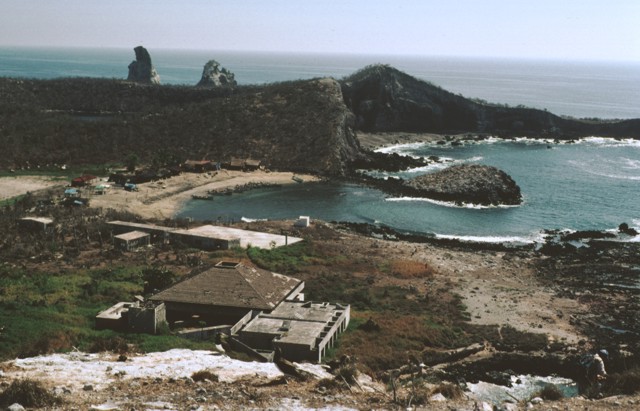
A 194-hectare volcanic island 70 km off San Blas. Thousands of nesting frigatebirds and blue-footed and other boobies are so unafraid of people that you walk among their nests, and from the island's peaks you look down into a crater lake. Frigatebirds puff their red throat pouches from the low trees while blue-footed boobies dance and nest on open ground right beside the trails.
Practical
Federal national park since December 8, 1980 (194 ha, CONANP), now a protected natural area with a UNAM (National Autonomous University of Mexico) research station on the south shore. It is uninhabited apart from seasonal fishermen and researchers, and has only very basic infrastructure. There's no water, fuel or supplies, so arrive self-sufficient. Land the dinghy at the fish-camp cove on the south side. Well-marked trails cross the island. Birds nest close to the paths: don't touch them or chicks, keep your voice down, and step around protective parents (2022 cruiser report). Tour boats from San Blas take about four hours each way, and tour visitors camp if sea conditions prevent a same-day return. No official charts of the island exist, guidebook chartlets disagree, and the bottom is mostly rock, so dive or watch your anchor. Highest point is 140 m. Landing is allowed only at Bahía Tiburoneros (the south-side fish-camp cove), yachts must anchor off that cove, trail groups are capped at 8 including the guide, and a per-person park fee applies. See 'Isla Isabela Park Rules (CONANP)' for details. Since January 8, 2024, the surrounding 31,696 ha of sea has been a separate national park (Zona Marina de la Isla Isabel), where anchoring is allowed only at authorized sites. Nesting season brings eggs, small chicks and gangly juveniles; booby parents will challenge you if you pass close to a nest. Brown pelicans, gulls and other boobies also nest here; the tourism board says more than nine species reproduce on the island. Under the park rules (DOF, 2006) it is a federal offense to feed, chase or disturb nesting birds, remove nests or eggs, or land pets; flying below 500 m within 2 km of the island needs authorization, which rules out drones.
Best for
Walking among nesting boobies and frigatebirds
Season
Nov–May (cruising season); nesting activity peaks in spring
Nearby
- Isla Isabela Crater Lake Lookout0.1 NM away
- Isla Isabela Park Rules (CONANP)0.1 NM away
- Bahía Tiburoneros Landing (Isla Isabela)0.2 NM away
- Isla Isabela South Anchorage0.2 NM away
- Isla Isabela East Anchorage0.3 NM away
- Las Monas Pinnacles (Isla Isabela)0.4 NM away
- Mexcaltitán Day Trip23.1 NM away
- Isla del Rey and Piedra Blanca (Tatéi Haramara)37.7 NM away